

Desmós
Stories, prayers, musings and other creative inspiration
to strengthen the BOND at Village Church.

Lent for Perfectionists: Freedom to Fast, Freedom to Fail
Lent is a season of preparation. Through these 40 days of reflection and repentance, we prepare our hearts and our lives to embrace Jesus’ passion—his death and resurrection on our behalf. This time is meant to stretch us in ways that both expose our need for Christ’s redemptive work and that invite us to apply it to our lives: what needs to be “put to death” in us? How is Jesus calling us to walk in newness of life? (Rom. 6:1-12)
This is the spirit with which we approach the disciplines of prayer, almsgiving, and fasting. These ancient practices are tools in God’s hand to help us ask the above questions with greater clarity. They are diagnostic in the sense that they help to reveal the extent to which we “drink from cisterns” other than Christ (Jer. 2:13), and they are therapeutic in the sense that they help us to practice reliance on and devotion to Christ alone.
Here is what the disciplines are not intended to be: performative. We do not fast, pray, or give alms to earn God’s favor or escape his displeasure. Lent is not about what we can prove to ourselves or anyone else. Rather, Lent is about embracing what God has already proved: we need a Savior, and His name is Jesus.
So as you take up Lenten practices, remember that they are just that: practices. They help us to practice our faith by leading us to repentance and by inviting us to strive for the holiness that is our birthright. If you fail to keep them as you intend, that’s part of the point. However you come to the end of these 40 days, expect to come to the end of yourself—so that you can find yourself anew in Him.

A Holy Saturday Reflection
John 18
38 After these things Joseph of Arimathea, who was a disciple of Jesus, but secretly for fear of the Jews, asked Pilate that he might take away the body of Jesus, and Pilate gave him permission. So he came and took away his body. 39 Nicodemus also, who earlier had come to Jesus by night, came bringing a mixture of myrrh and aloes, about seventy-five pounds in weight. 40 So they took the body of Jesus and bound it in linen cloths with the spices, as is the burial custom of the Jews.41 Now in the place where he was crucified there was a garden, and in the garden a new tomb in which no one had yet been laid. 42 So because of the Jewish day of Preparation, since the tomb was close at hand, they laid Jesus there.
--
If you’ve ever buried a loved one, you know the bizarre feeling when the focus shifts from your loved one to your loved one’s body. Death has taken your loved one away, and all you have left is a body. And if you’ve ever buried a loved one you might also remember the great care and honor you want to show that body. In the absence of full communion, proper care for the body is the only way you have left to love that person.
Sometimes, the attention and energy it takes to make all the necessary arrangements can distract you from the actual work of grief. So you give yourself to the tasks of bereavement but it’s not until the funeral is over and everyone has gone home that the finality of death hits you.
This is Holy Saturday. It’s the adrenaline crash, the letdown, the moment after the tomb is shut and Jesus’ disciples have nothing left to do but wait.
What are they waiting for? We know, but they don’t. Jesus had predicted his resurrection many times but none of them really comprehended him. Even ancient people understood the finality of death. In his affliction, Job wrote, “For there is hope for a tree, if it be cut down, that it will sprout again, and that its shoots will not cease...But a man dies and is laid low; man breathes his last, and where is he? As waters fail from a lake and a river wastes away and dries up, so a man lies down and rises not again.” (Job 14:7-12)
In a similar way, we also fail to fully grasp the promise of resurrection. We believe it, we proclaim it, we anticipate it. But we still live in a world full of tombstones. We still live in bodies that break down and decay and die. We still wait.
Jesus was buried in anticipation of the Sabbath, the seventh and final day of the week. For this reason some Christian traditions call Holy Saturday “the great Sabbath,” the day God rested after his finished work on the cross. Tomorrow then becomes “eighth day,”— the dawn of something totally new.
As Christians, we live in the eighth day. We are Easter people; our lives are marked by resurrection and new life. But we also live in Holy Saturday, waiting— some of us in graves— for new creation to fully dawn. We sleep and we weep and we wait, with hope.
A Good Friday Reflection
Ps. 22
1 My God, my God, why have you forsaken me?
Why are you so far from saving me, from the words of my groaning?
2 O my God, I cry by day, but you do not answer,
and by night, but I find no rest.
3 Yet you are holy,
enthroned on the praises of Israel.
4 In you our fathers trusted;
they trusted, and you delivered them.
5 To you they cried and were rescued;
in you they trusted and were not put to shame.
6 But I am a worm and not a man,
scorned by mankind and despised by the people.
7 All who see me mock me;
they make mouths at me; they wag their heads;
8 “He trusts in the Lord; let him deliver him;
let him rescue him, for he delights in him!”
9 Yet you are he who took me from the womb;
you made me trust you at my mother's breasts.
10 On you was I cast from my birth,
and from my mother's womb you have been my God.
11 Be not far from me,
for trouble is near,
and there is none to help.
---
After our daughter was born, I experienced a brief but intense bout of postpartum depression (hormonally induced feelings of sadness and overwhelm— typically called “baby blues”—are common in the first few weeks after birth). I remember sitting outside one sunny morning hoping that my mind—and my newborn baby— would cooperate with a time of prayer. Hoping that prayer would help to lift the cloud that seemed to persist over me.
I opened my Bible to the psalm of the day: “My God, my God, why have you forsaken me?” The tears flowed freely after that opening line. God’s Word met me that morning in a place I didn’t expect. Rather than ask me to cheer up, to practice gratitude, or to focus on the work ahead (all good things), Psalm 22 gave me words to articulate exactly how I felt in the moment. It showed me how to turn anguish into prayer.
What’s interesting about this particular psalm is how it reads like a conversation. “Why have you forsaken me? -Yet you are holy… But I am a worm and not a man… -Yet you are he who took me from my mother’s womb.” In his turmoil, the psalmist engages in a kind of call-and-response with himself as he cries out to God. This is often what faith feels like in real time. Difficult life experiences disorient us, but we keep returning to the refrain of hope.
Of course, our greatest song leader in this music of faith is Jesus Himself. It’s hard to imagine how he, the perfect human being, could have felt far from God. But the words of Psalm 22 were among his last. He showed us what it looks like to ask God “why?” while remaining faithful to Him nonetheless. He stayed on the cross, entrusting himself to His Father even when he felt abandoned by Him.
The reason this can comfort us is because we know that Jesus’ story did not end in the grave. Ultimately, he wasn’t abandoned by His Father. In his obedience, Jesus was fully vindicated. Now he has been given a name above every name. Jesus’ death and resurrection is the ultimate call-and-response between God and humanity. It reminds us where the story is headed, even in those moments or seasons when it seems like we are calling into the void.
What’s more, Jesus’ own ability to pray this prayer reminds us that we have a high priest who can sympathize with our weakness. He knows what it is like to be on the human side of this psalm, to suffer in a body and to feel the sting of shame and betrayal. And because he has gone before us into Heaven, because He now represents us before the Father, we can cry out to God with confidence. Here's what that looks like:
First, we can be confident that we will not be put to shame in our struggle. He does not despise our weakness, he understands it. If Jesus asked, “why?” then so can we. Second, we can be confident that God does in fact hear us when we pray. That in and through Christ, God has already answered our deepest questions and met our deepest needs. And third, we can be confident that Christ will supply us with what we need to be faithful until we see Him. He sends his very Spirit to help us— to keep the song of faith on our lips and even to sing it over us when we forget the words. So let’s sing on.
A Maundy Thursday Reflection
Ps. 78
15 He split rocks in the wilderness
and gave them drink abundantly as from the deep.
16 He made streams come out of the rock
and caused waters to flow down like rivers.
17 Yet they sinned still more against him,
rebelling against the Most High in the desert.
18 They tested God in their heart
by demanding the food they craved.
19 They spoke against God, saying,
“Can God spread a table in the wilderness?
20 He struck the rock so that water gushed out
and streams overflowed.
Can he also give bread
or provide meat for his people?”
21 Therefore, when the Lord heard, he was full of wrath;
a fire was kindled against Jacob;
his anger rose against Israel,
22 because they did not believe in God
and did not trust his saving power.
You could say that the root of sin is forgetfulness.
God has always spoken to His people in word and deed. From the beginning, He has asked us to trust Him by demonstrating that He is trustworthy. In Eden, He provided for our every need before asking us to abstain from the one tree. In the Exodus, He delivered us from slavery and brought us safely through the sea. He proved his track record before asking us to follow Him in the wilderness.
But we are good at forgetting. We fall prey to the question, “Did God really say….?”, allowing the tempter to twist even our memory of God’s goodness and authority. In the psalm, God’s people sinned not by asking for the food they craved, but by doubting God’s character and competence to provide for their needs. They forgot who He is (good) and what He is like (able).
This is why the Psalms are replete with storytelling: the antidote for our doubt and disbelief is to remember the story of God’s power and provision. When we recall God’s deeds from the past, we are more likely to trust Him for the future. In this way the Psalms teach us to pray. Even Jesus, as he hung on the cross, prayed the psalms. In the darkest, most bewildering moment of his life, Jesus rehearsed the truth of God’s faithfulness.
Sometimes we can’t trust our own senses. We get lost in the fog of grief and confusion (or just the uncomfortable reality of life in a body that gets hungry and tired and cold). But we can remember what has always been true: God is good. He is for us. We can trust Him, even when He’s asking us to walk into the sea. Or to strike a rock. Or to carry a cross.
And when we fail to trust, as we often do, we can remember that He provides anyway. That His ultimate, once-for-all response to our grumbling and disbelief is to feed us with the food we crave but don’t expect Him to give. The psalm goes on:
23 Yet he commanded the skies above
and opened the doors of heaven,
24 and he rained down on them manna to eat
and gave them the grain of heaven.
25 Man ate of the bread of the angels;
he sent them food in abundance.
God’s goodness isn’t dependent on our deserving. That’s the point. That’s why when God became flesh, He washed the feet of the men He knew would betray him. It’s why He offered them the bread and the wine on their last night together. It’s why He still does, every time we hold out our hands to receive it. He sends us Himself in abundance. Our job is to remember that this is true, to get quicker at coming to Him in our hunger and thirst.
One last thing: in this work of remembering, God has also given us each other. He has brought us through the sea together so that we can remind one another of who God is and what He has done. Our collective memory makes us like a living psalm, allowing us to call each other out of forgetful distrust and into expectant faith. This is what we do when we gather on Sundays but it's also how we are called to live together Monday through Saturday. It's not easy, but it's a gift. It reminds us that even our faith is not ours alone to carry-- that sometimes, when the story gets scrambled in our minds and we have trouble believing what is true, the faith of the church can carry us. So even if you can't remember what God is like, remember that you are not alone.
A Holy Wednesday Reflection
Hebrews 9
22 Indeed, under the law almost everything is purified with blood, and without the shedding of blood there is no forgiveness of sins.
23 Thus it was necessary for the copies of the heavenly things to be purified with these rites, but the heavenly things themselves with better sacrifices than these. 24 For Christ has entered, not into holy places made with hands, which are copies of the true things, but into heaven itself, now to appear in the presence of God on our behalf. 25 Nor was it to offer himself repeatedly, as the high priest enters the holy places every year with blood not his own, 26 for then he would have had to suffer repeatedly since the foundation of the world. But as it is, he has appeared once for all at the end of the ages to put away sin by the sacrifice of himself..
The concept of sin is simple, but it isn't easy. It's difficult to accept that human beings were created for a certain purpose (for our own good, for the good of others and for the good of all creation) but we fall short of it. We try, but we fail. Why? Because beneath the hood of that deficit is a false conception of what's good for us, for others and for creation. We do it our own way because we think in terms of our own way. And that's what breaks the world.
We were given these lives by God and he has expectations for them. How could he not? What he desires leads to the best possible outcomes, even if they remain obscure to us. That's why we follow. That's why we obey. Or not. We like our perceived outcomes better. We like what we like and assume it's right. How could it not be?
The concept of sacrifice is also simple, but not easy. When we fall short, there is a gap between what should be and what is, what's actually good and what we think is. It's not a spectrum. The difference between the two is as stark as life and death. To address that gap, that deficit, that difference, God has acted. He provides. Because God is merciful and committed to the purpose for which he created us even when we aren't, he doesn't cast us aside as failures. He provides a way. A "mediation" for sin. Something that can be done about it that speaks the language of life and death in no uncertain terms. Blood.
The sacrificial system of ancient Israel was a foreshadowing. God provided this way for the priest (a representative) to stand in the gap for everyone else. To acknowledge the deficit and to actually do exactly what God said to do in that very specific way. It was pure honesty and obedience. The priests and the sacrifices came and went. Until Jesus. When he became the priest and the sacrifice for us, nothing but him would ever be needed again. Always him. He appears in the presence of God on our behalf.
What this means is simple, but not easy. We are forgiven when we ask. Fully. But often we don't feel like we are. Our sin can feel defeating and hopeless sometimes. Too big for forgiveness and bloodier than the cross. Often our exasperation leads to acceptance of our sin, resignation or even justification borne of defeat. But I am certain of this: The power to overcome our sin and its power over us is found in the power of forgiveness. It's found when we really accept that Jesus is really enough. Once for all.
I need you and you need me because we both need Jesus. This is why we share the Holy Spirit of adoption as sons and daughters of God. This is why Jesus founded the Church and why, together, we celebrate the last Passover ever needed every week: To proclaim the Lord's death until he comes. To remember, really remember, Jesus is enough and to give thanks.
A Holy Tuesday Reflection
1 Corinthians 1
18 For the word of the cross is folly to those who are perishing, but to us who are being saved it is the power of God. 19 For it is written,
“I will destroy the wisdom of the wise,
and the discernment of the discerning I will thwart.”
20 Where is the one who is wise? Where is the scribe? Where is the debater of this age? Has not God made foolish the wisdom of the world? 21 For since, in the wisdom of God, the world did not know God through wisdom, it pleased God through the folly of what we preach to save those who believe. 22 For Jews demand signs and Greeks seek wisdom, 23 but we preach Christ crucified, a stumbling block to Jews and folly to Gentiles, 24 but to those who are called, both Jews and Greeks, Christ the power of God and the wisdom of God. 25 For the foolishness of God is wiser than men, and the weakness of God is stronger than men.
. . .
Where is the debater of this age? He's right here. Typing.
I have never ceased to have questions about this ancient faith, even though it has come to be "what I do" as a pastor. I have tried to engage all the intellectual arguments against Christianity. I have taken seriously the valid accusations against the Church and her tendency toward power and the corruption it breeds. Even now, I could chew nails thinking about the problems of the American Church, but I can do little more than try to be a different American church at 2104 Old Buncombe Road with you.
What I have found, despite all the doubts that have nagged me, is that the cross with God himself hung upon it makes no sense at all and yet it makes the absolute best sense of everything. What I mean is, it doesn't explainanyone into faith, really. It's not the answer or the "aha" simply because, fully understood, it coherently addresses the perennial struggle humans have to put goodness, truth and beauty at the center of our common life - or even our own lives, for that matter.
But the cross does indeed continue to draw people to to divine love and healing. To trust. To a place of absolute dependence when all our arguments have run out and our debates have ended with only fragile and fleeting peace. The cross is still wiser than the wisdom we can stuff into the tiny constructs we confuse with omniscience, the confidence we get by on so long as we still believe we have real control and progress.
The cross is not a concept or an explainer, really, though its meaning is rich. The cross is the place and time in history where the love of God was irrevocably and irreversibly poured out for Jews and Gentiles. It's a flow that cannot be reversed and a fact that cannot be explained out of history. It is the "through-line" for an otherwise wobbly world. It is still saving, even if it makes no sense.
We have our doubts. The Church has her failures. The debates rage. But in spite of us, the cross will never lose its power. It will hold on to us and the whole world even when we feel our grip is loosening. That's why I still believe. That's why anyone does, really. Because of its wisdom and power, not yours or mine.
A Holy Monday Reflection
Isaiah 42
1 Behold my servant, whom I uphold,
my chosen, in whom my soul delights;
I have put my Spirit upon him;
he will bring forth justice to the nations.
2 He will not cry aloud or lift up his voice,
or make it heard in the street;
3 a bruised reed he will not break,
and a faintly burning wick he will not quench;
he will faithfully bring forth justice.
4 He will not grow faint or be discouraged
till he has established justice in the earth;
and the coastlands wait for his law.
Three things in this passage encourage me. I hope they'll encourage you today.
First, the chosen servant about whom Isaiah is prophesying is Jesus, who didn't bring about justice by getting loud and working everyone up into a riot. The last thing we need now (or ever needed) to deal with the problems of the world is another show, more grandstanding, more empty words and hollow moral outrage that lasts a week or three. We're buried in that. It doesn't really work, especially when suffering has found us in our living rooms on a Monday.
Second, we're vulnerable and Jesus knows this even when we try to hide or deny it. He knows us. He sees how it's actually going even when we say, "Fine." My favorite metaphors in all of Scripture are here in verse 3, reminding us of the compassion and sensitivity of our Savior. He doesn't break an already bruised and delicate reed, a seemingly irreparable thing. He doesn't snuff out a struggling spark gasping for fuel. Maybe you feel like that now, bent over, obscure, faint in body, mind and Spirit. Nothing left to give. Jesus isn't just there to fix you and move on. He's there with you as you are. That's where he wants to begin.
Third, just what verse 4 says: He will not grow faint or be discouraged till he has established justice in the earth. Not just abstract, sweeping justice for the world, but the help and vindication you need where you are and how you are. He's here for that and though you might be discouraged and done, he's just not. He never is. So take heart. Or, at the very least, take hold. He's holding you...
...the passage goes on to read:
5 Thus says God, the Lord,
who created the heavens and stretched them out,
who spread out the earth and what comes from it,
who gives breath to the people on it
and spirit to those who walk in it:
6 “I am the Lord; I have called you in righteousness;
I will take you by the hand and keep you...

An Advent Note from Bishop Wood
Dear Friends,
In the title essay of her collection of essays, When I Was a Child I Read Books, the author, Marilynne Robinson recounts her days growing up accompanied by the inherent loneliness of Idaho landscape and the enduring positive benefit of this kind of loneliness. She notes that for Americans of a certain era such emotions as mourning, melancholy, regret, and loneliness were “high sentiments, as they were for the psalmist and for Sophocles, for the Anglo-Saxon poets and for Shakespeare.” Being a child of the Midwest with family still scattered across her hills and hollows along with a son who with his family live in Montana, Robinson’s essay was resonant.
All of this was brought to mind with the advent of Advent and having recently returned from a week in South Dakota where I was struck again by the beautiful loneliness of the post-harvest landscape - with winter settling in - and the long wait ‘til spring.
These high sentiments of mourning and melancholy and loneliness are often my companions. I experience them in the solitude of life. Sometimes in the poetry of a Herbert or Whitman or Donne, other times listening to the “wh-who’s” of the owls and howls of the coyotes while walking through the chilly black woods under a full November moon.
This week we, the church universal, mark the beginning of our church year with the season of Advent. The season of Advent is a season of preparation as we prepare to celebrate the birth of Christ. Our seasonal collects and hymns have as their backdrop the prophetic witness to the people of Israel waiting in their “lonely exile” for their Messiah. They mark as well our waiting in a lonely exile as a peculiar people for the Messiah’s second advent. The church seasons are meant to help us navigate the landscape of our inner being. They can, at their best, give shape and rhythm to our spiritual life. They can, at their best, provide the opportunity to recognize and embrace aspects of our life we might wish to ignore - all within the context of the faith and our community of faith.
The season of Advent is a season of preparation as we prepare to celebrate Christ’s birth. We live as some have said, “in between the times.” Meaning that we live between the incarnation and the final consummation of Christ’s return And in this waiting, I find a sense of the high sentiments of which Robinson wrote. I find myself saying often with the biblical writers, “Maranatha” - “come, Lord.” I find myself waiting and wondering with the Psalmist who asks, ‘how long?” How long until our Lord’s triumphant Advent?
So, how can Advent help us navigate the inner landscape of our soul?
Well, we do know something of Christ as we await the final consummation. We are not left as orphans. He has come. He has given us His Spirit. And so, our waiting is a patient waiting. Patient because we have confidence in Christ and His promise to return. Patient because of His promise that He will set all things right. Patient because of His promise that there will be a day and a place where there will be no more tears, a day and a place where we will see Him face-to-face. This confident patient waiting can give us - if and as we cooperate with the Spirit’s work in our lives - the opportunity to examine and address those hindrances and obstacles in our lives: our crooked paths, our rough places. This waiting though is suffused with inherent
loneliness and longing. A loneliness and a longing that allows one to, in Robinson’s words, “experience . . . radical singularity, one’s greatest dignity and privilege.” That allows one to navigate the landscape of the heart and to discover again that our high sentiments and deepest desires are pointers that point to One thing - the One man, Christ Jesus - who alone is able to satiate our longing and desire.
Come, Lord Jesus.
In Christ,
+Steve

TOWN HALL RECORDING: The Bodies We Share (June 9th)
Below is a recording from the town hall where Seth+ discusses our recent communication on Christian identity and sexuality (you can read the initial statement here). As always, we invite dialogue around these important aspects of our faith and shared life. Reach out to any of our clergy if you'd like to follow up with a personal conversation.
Holy Saturday
Matthew 27:57-66
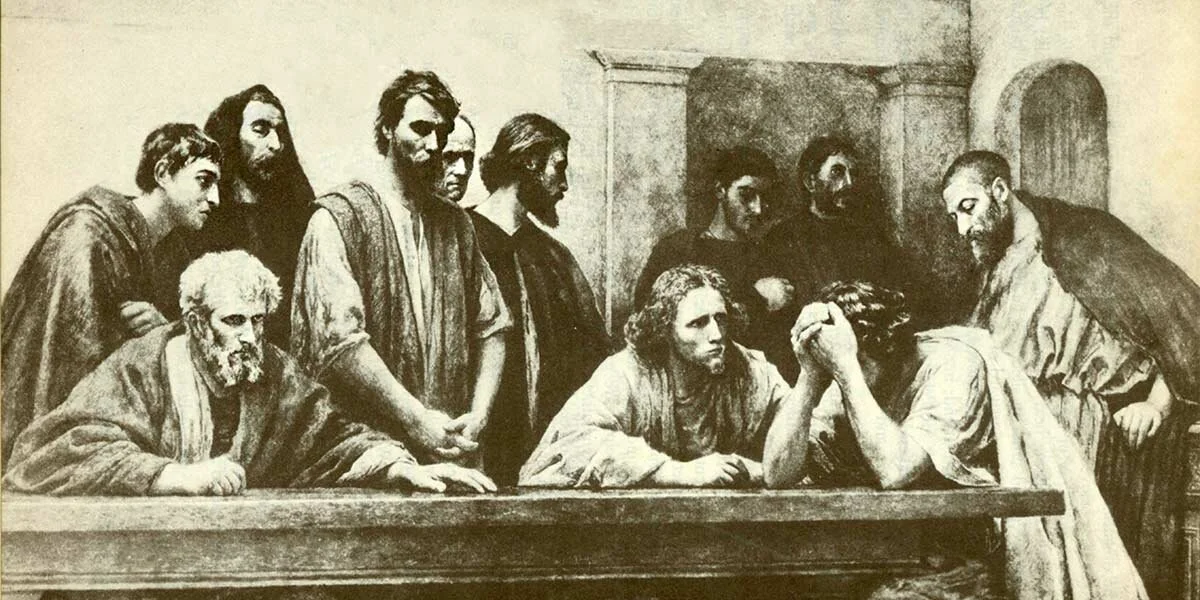
When it was evening, there came a rich man from Arimathea, named Joseph, who was also a disciple of Jesus. He went to Pilate and asked for the body of Jesus; then Pilate ordered it to be given to him. So Joseph took the body and wrapped it in a clean linen cloth and laid it in his own new tomb, which he had hewn in the rock. He then rolled a great stone to the door of the tomb and went away. Mary Magdalene and the other Mary were there, sitting opposite the tomb.
The next day, that is, after the day of Preparation, the chief priests and the Pharisees gathered before Pilate and said, "Sir, we remember what that impostor said while he was still alive, `After three days I will rise again.' Therefore command the tomb to be made secure until the third day; otherwise his disciples may go and steal him away, and tell the people, `He has been raised from the dead,' and the last deception would be worse than the first." Pilate said to them, "You have a guard of soldiers; go, make it as secure as you can." So they went with the guard and made the tomb secure by sealing the stone.

Holy Saturday by Eugene Burnand
A Better Resurrection
by Christina Rosetti
I have no wit, no words, no tears;
My heart within me like a stone
Is numb'd too much for hopes or fears;
Look right, look left, I dwell alone;
I lift mine eyes, but dimm'd with grief
No everlasting hills I see;
My life is in the falling leaf:
O Jesus, quicken me.
My life is like a faded leaf,
My harvest dwindled to a husk:
Truly my life is void and brief
And tedious in the barren dusk;
My life is like a frozen thing,
No bud nor greenness can I see:
Yet rise it shall—the sap of Spring;
O Jesus, rise in me.
My life is like a broken bowl,
A broken bowl that cannot hold
One drop of water for my soul
Or cordial in the searching cold;
Cast in the fire the perish'd thing;
Melt and remold it, till it be
A royal cup for Him, my King:
O Jesus, drink of me.
My Lord, today all is silent. You have given Your precious life for the salvation of the world. You died a horrific death, poured out all Mercy from Your wounded Heart, and now You rest in peace in the tomb as the soldiers keep vigil.
Lord, may I also keep vigil with You as You sleep. I know that this day ends with Your glorious triumph, Your victory over sin and death. But for now I sit quietly mourning Your death.
Help me, dear Lord, to enter into the sorrow and the silence of this Holy Saturday.
As I keep vigil, awaiting the celebration of Your Resurrection, fill me with hope. Help me to look forward to the celebration of Your Resurrection, but also to look forward to the hope of my own share in the new life You won for the world. I entrust my whole being to You, dear Lord, as You lay lifeless and still. May Your rest transform the brokenness of my own soul, my weaknesses, my sin and my frailty. You are glorious and You bring the greatest good out of Your apparent defeat. I trust in Your power to do all things and I entrust my life to You. Jesus, I trust in You.
Good Friday
by Father Seth Cain
They stare and gloat over me. (Ps. 22:17)
It’s Good Friday.
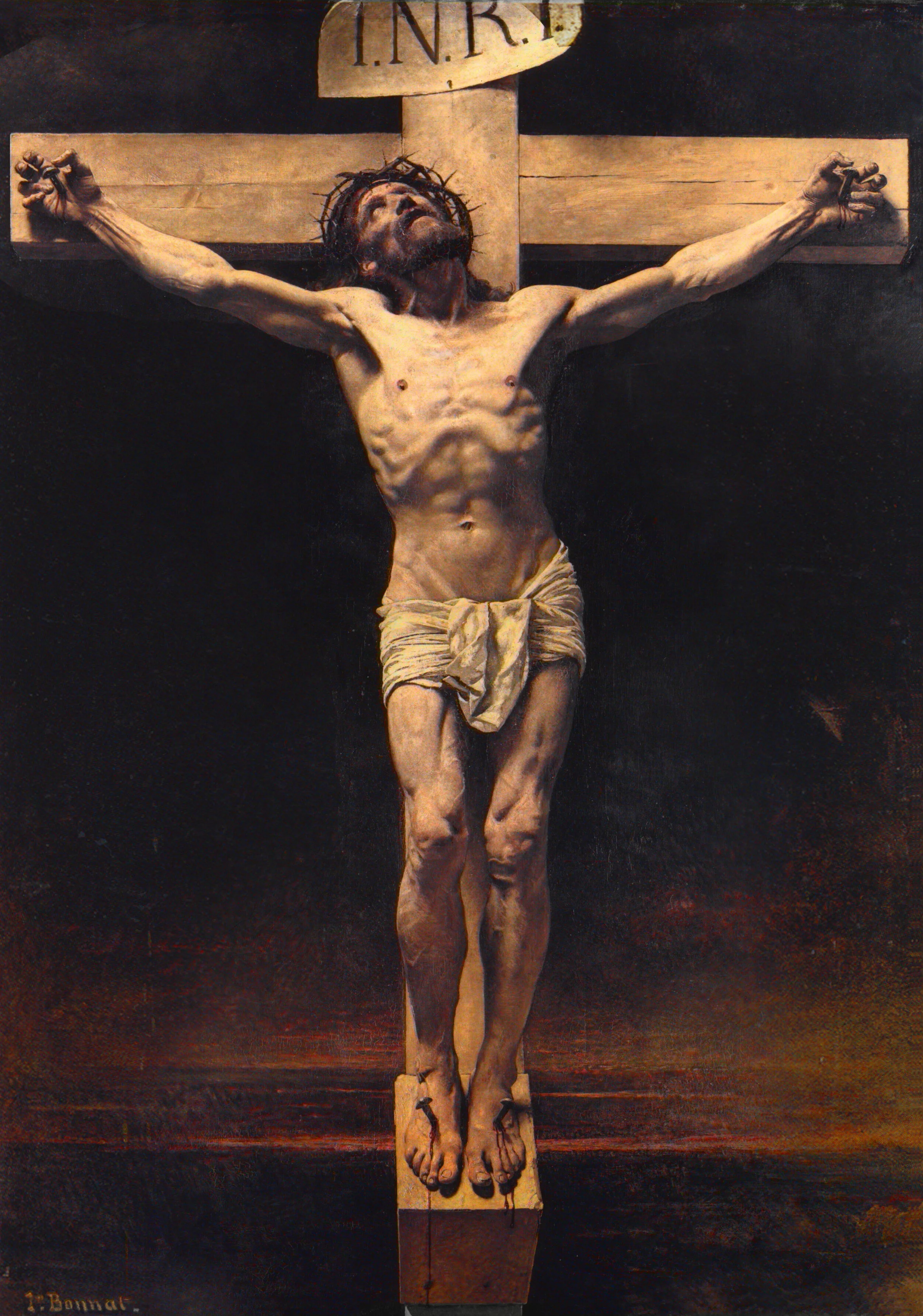
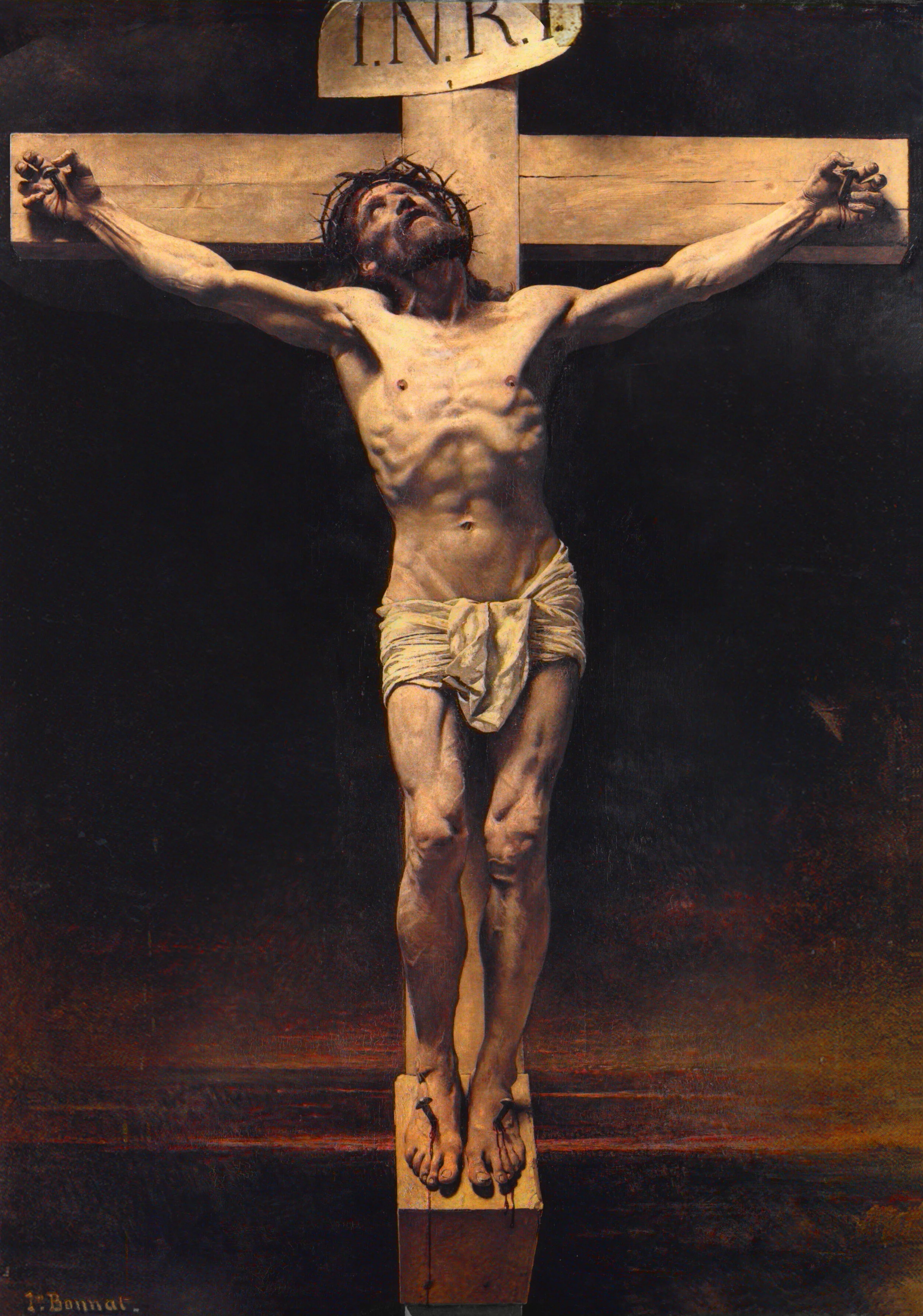
This depiction by Léon Bonnat of Calvary (1874) is one of the hardest for me to look at. No, it’s not the most graphic image of what Jesus endured. The use of red is sparing, more noticeable in the horizon than on his body. It doesn’t depict Jesus wincing from pain, crying out in agony, or slumping in exhaustion. (His tense hands are the sole indication of the pain. Look at his thumbs, especially).
Bonnat shows him suspended alone on a brooding sky, hanging in relief against the ominous, three-hour darkness. Wood and skin seem almost blended together in color and shade. Jesus has become the curse of the tree on which he is hung. He is alone in it, save the mockery.
Then all the disciples left him and fled. (Matthew 26:56)
And those who passed by derided him, wagging their heads and saying, “You who would destroy the temple and rebuild it in three days, save yourself! If you are the Son of God, come down from the cross.” So also the chief priests, with the scribes and elders, mocked him, saying, “He saved others; he cannot save himself. He is the King of Israel; let him come down now from the cross, and we will believe in him. 43 He trusts in God; let God deliver him now, if he desires him. For he said, ‘I am the Son of God.’” And the robbers who were crucified with him also reviled him in the same way. (27:39–44)
There were also many women there, looking on from a distance, who had followed Jesus from Galilee, ministering to him, among whom were Mary Magdalene and Mary the mother of James and Joseph and the mother of the sons of Zebedee. (v. 55, 56)
Scarcely a soul would dare risk coming near this accursed man. Those who pass by more closely will distance themselves with searing insults and taunts. The women who doted on him so closely in life now look on him from a distance as he dies.
Once upon a time, James and John asked to be on Jesus’ right and left when he comes into his glory. Jesus replied, “You do not know what you ask for.” Far from their imaginations of it, Jesus’ incomparable glory would be revealed as he is lifted up from the Earth in lonely agony on a cross to take away the sins of the world. Beside him instead are two denigrating thieves. In this case, and at least until one becomes desperate, common suffering does not even produce commonality or empathy.
Jesus, the only true human being, will hang devoid of all human connection, touched only once after being hammered down — just a sour sponge upon his lips.
After many years in life and ministry, I’m convinced loneliness is one of the most powerful motivators in human experience, if not the most. The emotion is at times so hollowing, it produces some of the most impulsive decisions, thoughtless actions and profound consequences I can think of. We make absurd statements and spin personal fables to gain even temporary attention. We strive to impress by contouring our bodies and crafting our images, hoping to linger in the admiration of those we admire (or anyone who will take notice). We remain silent in miserable relationships, even enduring abuse, to avoid the greater evil of being alone. We grow impatient and demanding with our spouses, expecting in the immediate an intimacy that can only come over years.
We are often so desperate to put another lonely body against ours, deferring the consequences or magnifying silver linings in tarnished relationships. We are haunted by the possibilities of an endless scroll of digital interactions and right-swipes. And sometimes we just anesthetize our desolation into a chemical oblivion. Down to the last ounce, the weight of our insecurity and the heft of its consequences hung on our loneliest Lord.
Now from the sixth hour there was darkness over all the land until the ninth hour. And about the ninth hour Jesus cried out with a loud voice, saying, “Eli, Eli, lema sabachthani?” that is, “My God, my God, why have you forsaken me?” (vv. 45, 46)
These words are not to be read as the Father’s absolute rejection of Jesus, though they do announce what our sin feels like on his weakening heart over against the righteousness of a holy Father. It is pure, isolating agony.
More clearly, Jesus’ cry is to the only One with him in his suffering, who also feels out of reach in this void to which our unrighteousness subjected him. What our suffering Savior feels goes straight to his Father as an invocation of the Psalmist who locates his own salvation in God alone. Jesus desperately seeks the only one who can (and will) save him — if he will come near.
Jesus cries out as God’s psalm for the world. For us.
And Jesus cried out again, and yielded up his Spirit. (v. 50)
Maundy Thursday

It’s Maundy Thursday.
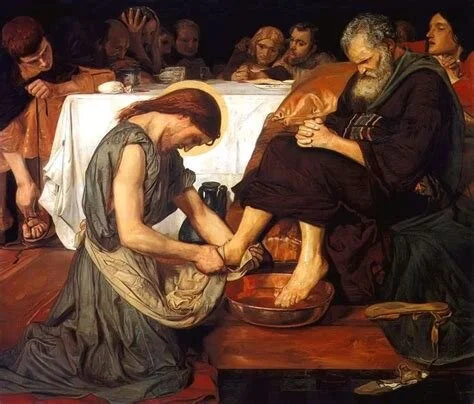
The painting you see above had to be changed for reasons as compelling as its imagery. Madox Brown originally painted Jesus without enough clothing to satisfy critics and potential buyers. It remained unsold for several years until the artist retouched the figure of Christ, giving him robes.
Such a response reveals more about us than it does about Jesus (or the artist, for that matter). We know from the Gospels that whatever Jesus wore while washing his disciples’ feet, it was less than he had on when he began. He stripped down. Took off. He meant to communicate something unsettling in its basic expression: a radical example of servanthood so unnerving that we might hold our heads as one disciple above is doing. Jesus, who had already lived his adult life as a man with “no place to lay his head,” was beginning to empty himself for others in truly discomfiting ways.
Jesus lived his life naked, in a sense. But we’re the ones who negotiate life around shame and insecurity. So it’s hard for us to see him that willing, open and exposed. It’s even harder for us to heed his example.
His humility was and is beautiful. But it makes us more aware of our own ugliness. Dorothy Sayers, borrowing Iago in Shakespeare's Othello, wrote that Jesus had “a daily beauty that made us ugly.” We are so full of ourselves. Christ emptied himself, first in heaven (Philippians 2) and then on earth. We can’t help but seek actualization of all our dreams in an earthly “heaven” of our own pursuits. Jesus, on the other hand, pursues us.
Maundy Thursday is not primarily about washing feet, though that is an important part of the story of Jesus’ last Passover. It’s about a deeper humility: the gift of Christ’s own body and blood. A meal made of love.
Many have objected to such an “ugly” thing. Eating his flesh and drinking his blood? Yes. It means, simply, he is giving his everything and we are taking it fully — his life into ours. We are feeding on him as though nothing else can fully satisfy. We are apart, but coming together in one eternal meal that unites all our diverse, but coordinated ugliness into the stark beauty of Jesus’ daily life, which was so hated as to be considered a threat.
It is a threat. It’s a threat to our pride, insecurity and our hopes in human achievement. It’s a threat to earthly fulfillment as an end in itself that pits us against one another, often unwittingly. It’s a threat to empty hope that appears full for a season, but leaves us choking down carob pods with the pigs.
Christ’s beauty is a threat, but it is also a promise. It’s the promise that if we will live on him and in him, our ugliness will be swallowed up in his beauty and this will not be the last or only spiritual meal we eat together. We will eat it again with him in his Kingdom. And it will be an incomparable feast.
We eat the meal of his death for our ugliness in the certainty of his victory over it and the joy of resurrection that awaits us beyond our “end.” In him and in his Meal, the beauty of the Kingdom becomes visible and tasteful in a world still made ugly and unbearably sour.
“Take, eat. This is my body.
Drink this (promise), all of you, for the forgiveness of sins.
Remember me.”
Today’s Prayer
Almighty Father, whose most dear Son, on the night before he suffered, instituted the Sacrament of his Body and Blood: Mercifully grant that we may receive it in thankful remembrance of Jesus Christ our Savior, who in these holy mysteries gives us a pledge of eternal life; and who lives and reigns with you and the Holy Spirit, one God, for ever and ever. Amen.