

Desmós
Stories, prayers, musings and other creative inspiration
to strengthen the BOND at Village Church.
Lent Day 19
by Matt Perez
Romans 7: 12-25
So the law is holy, and the commandment is holy and righteous and good.Did that which is good, then, bring death to me? By no means! It was sin, producing death in me through what is good, in order that sin might be shown to be sin, and through the commandment might become sinful beyond measure. For we know that the law is spiritual, but I am of the flesh, sold under sin. For I do not understand my own actions. For I do not do what I want, but I do the very thing I hate. Now if I do what I do not want, I agree with the law, that it is good. So now it is no longer I who do it, but sin that dwells within me. For I know that nothing good dwells in me, that is, in my flesh. For I have the desire to do what is right, but not the ability to carry it out. For I do not do the good I want, but the evil I do not want is what I keep on doing. Now if I do what I do not want, it is no longer I who do it, but sin that dwells within me. So I find it to be a law that when I want to do right, evil lies close at hand. For I delight in the law of God, in my inner being, but I see in my members another law waging war against the law of my mind and making me captive to the law of sin that dwells in my members. Wretched man that I am! Who will deliver me from this body of death?
Thanks be to God through Jesus Christ our Lord! So then, I myself serve the law of God with my mind, but with my flesh I serve the law of sin.

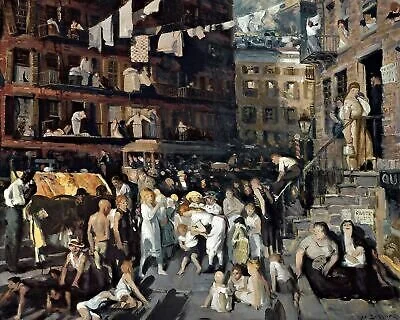
The Cliff Dwellers by George Bellows
We live in a dynamic, dramatic and distressing world. Our social landscape is a shifting, treacherous labyrinth of alternative facts, fluid identities, conspiracy theories, influencers of every flavor and news (fake or otherwise). Reality has become subjective, shaped by our tribal affiliations, biases and those bits of information we choose to recognize because they support our ideologies; we ignore any ideas or facts we don’t agree with. This egotistical subjectivity has made the concept of morality so broad and vague as to be almost useless. So long as you obey the law and don’t offend anyone, you are free to do as you wish. This chaos is devoid of real value, and leaves us lost, confused, but convinced we are right. Some call this the Post-Truth Age.
Within this context we Christians live our lives. Our work, play, family and social lives unfold within this world of hostile moral relativity. However, we know what is indeed right, as revealed in Scripture and through prayer. Though we know right from wrong, we live in a world in which almost every sin is perfectly acceptable. It is easy to stumble, indulge and make excuses for ourselves. Afterall, everyone is doing it, and they seem fine. We begin losing our way in a tangled web of distraction, sensuality and materialism. We know we’re going in the wrong direction, and we inhabit that uncomfortable place between sinner and saint; who we are now, and the person we want to be.
Because we are frail sinners, and we tend to drift away from God, the rhythm of our church calendar and the liturgy of our services are critical because they re-orient our focus toward what is truly important: our right relationship with the Lord. Sadly, as our world distracts us, even our weekly Sunday worship can come to be a chore or an obligation. Thankfully, we have the season of Lent. We are forced to confront our sin in a very real, intentional way. We are made to pause, and probe through our lives, searching all those places where we have gone astray and recognizing where our faith and practice have suffered. More than simply a guilt-trip, Lent is a call to action. We resolve to refuse to indulge the weakness of the sinner and instead borrow the strength of the saint, with the hope of keeping that strength. During Lent, we mark ourselves as truly a people apart by taking a firm stand in this corrupt world and making the bold claim that sin is indeed real, and by the grace of God, we will not give in.
Matt Perez lives in Lynchburg, Virginia. A plumber by trade, he enjoys Brazilian Jiu-Jitsu, hiking and just a little whiskey.
Lent Day 18
by Chris Badeker
Mark 8:31-39
And he began to teach them that the Son of Man must suffer many things and be rejected by the elders and the chief priests and the scribes and be killed, and after three days rise again. And he said this plainly. And Peter took him aside and began to rebuke him. But turning and seeing his disciples, he rebuked Peter and said, “Get behind me, Satan! For you are not setting your mind on the things of God, but on the things of man.”
And calling the crowd to him with his disciples, he said to them, “If anyone would come after me, let him deny himself and take up his cross and follow me. For whoever would save his life will lose it, but whoever loses his life for my sake and the gospel's will save it. For what does it profit a man to gain the whole world and forfeit his soul? For what can a man give in return for his soul? For whoever is ashamed of me and of my words in this adulterous and sinful generation, of him will the Son of Man also be ashamed when he comes in the glory of his Father with the holy angels.”

“Everything dies, baby, that’s a fact
maybe everything that dies
someday comes back"
"Atlantic City", Bruce Springsteen
In Mark 8, Jesus speaks plainly about the suffering which is to befall him. For Peter, however, this moment is a bridge too far. Peter's decision to intervene and Jesus' prompt rebuttal serves to illuminate the chasm that exists between Peter's expectations and Jesus' intentions.
It hasn't been that long since Jesus called to Simon (Peter), "Follow me. I will make you fishers of men!" Peter has seen Jesus' healings, His authority over spirits, and His command over nature. Even though it hasn't always been smooth sailing, Peter has dutifully followed his teacher through figurative and literal storms. Even more recently, Peter acknowledges Jesus as Christ. It must have been a rush to come to grips with the reality that your teacher is also the foretold Messiah. If Peter had followed tentatively at the outset, he now has cause to follow boldly.
Before this revelation can fully sink in, Jesus starts raining on the parade. What does Jesus mean when he says he must suffer? Rejected by the elders? Didn't he just confirm that He's literally the Messiah? Peter isn't having it. Jesus need not suffer many things, be rejected by the elders, and killed. What's more, Peter need not follow him there. Knowing now the path his teacher, his Christ, plans to lead him down, Peter switches into action mode and rebukes Jesus.
We aren't privy to exactly what Peter says in this rebuke. What we do know is that Jesus blasts back with perhaps his most infamous one-liner and then calls everyone together for a brief DTR. “If you're going to be my disciple, you'll deny yourself, take up your cross, and follow me.” I expect that the reiteration of the command to follow is not lost on Peter. Then again, a lot was lost on Peter, so I suppose it's really anyone's guess.
Jesus dispels the notion that Peter's dissuasion attempt was motivated by altruism. Just as soon as He has admonished his disciples to follow Him, He adds that "whoever seeks to save their life will lose it". Put another way, you could hear it as, "Peter, your concern isn't for me, it's for yourself." Being fully human, Jesus understands our desire to self preserve. Jesus himself prayed in Gethsemane that God might take the cup of suffering from Him. Thankfully, being fully God, Jesus also understood that nothing can be resurrected that hasn't already been put to death.
In saying to Peter, "Get behind me, Satan", Jesus is simultaneously extremely shocking and incredibly astute. Peter is attempting to course correct Jesus onto a path filled with more miracles, more acclaim, and most importantly, no crucifixion. Why rise again if you need never fall? Peter would see Jesus be the king of earth, but not the king of heaven. Peter would see Jesus leap from the rocks to be caught by angels, turn the stone into bread, and leave the veil untorn.
As if He sees this entire path laid out before him, beckoned onward by Satan to indeed, rule here on earth, Jesus asks the group a question. “What good is it for someone to gain the whole world, yet forfeit their soul?” Jesus utterly rejects the leveraging of his position for acclaim. He pivots by fixing his gaze on the day He will "come in his Father's glory with the holy angels". This is a destination that the path of Peter could never lead him to.
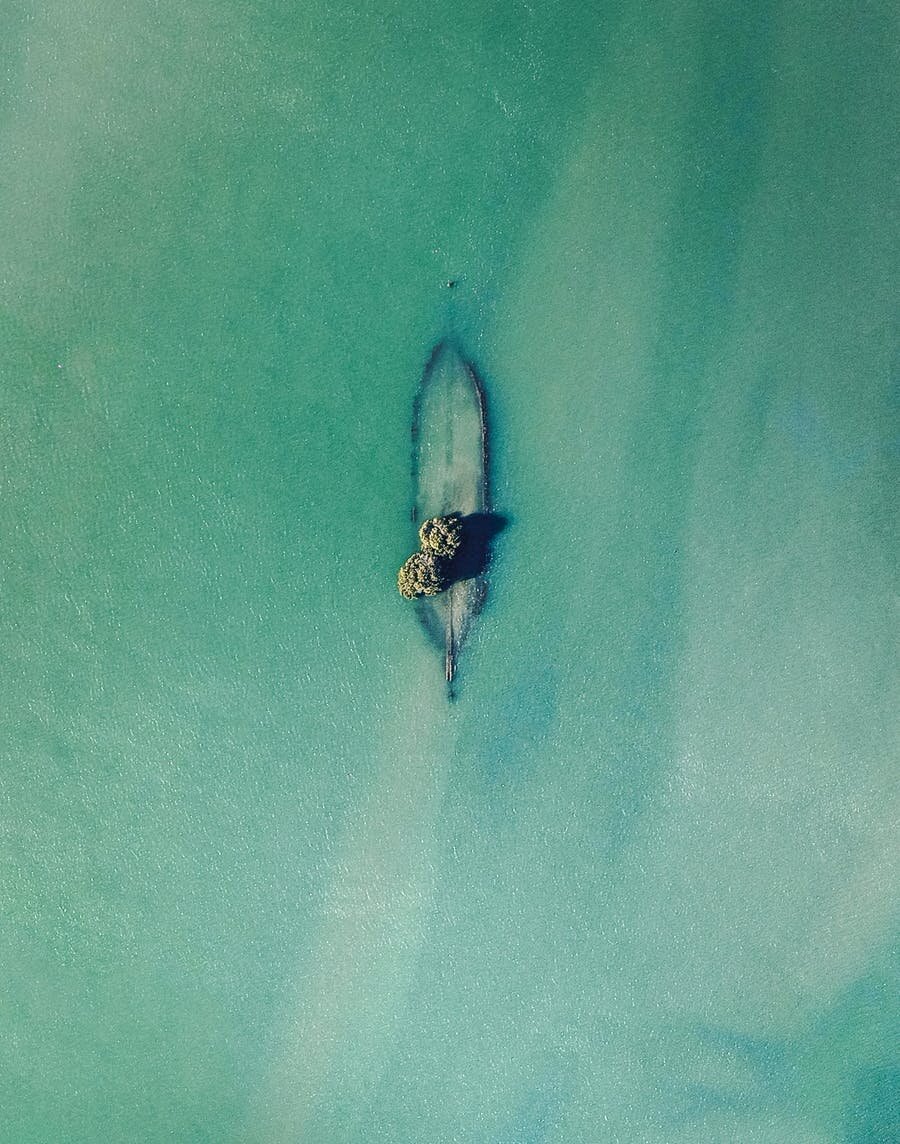
The path of Jesus, and his disciples, is not one of self preservation, but self denial. Eventually Peter follows Jesus on this path; pray we do too. It's a paradoxical path where anything that wishes to live must first willingly lose its life. A path where what is given in bondage to Christ and the gospel is ultimately set free. It's a path that leads to a cross, a path that leads to death, and a path where everything that dies someday comes back.
Chris Badeker is one half of the musical duo Wild Harbors. He lives, works, and eats in Nashville, TN with his wife Jenna and two rabbits named Duncan and Sassafras. You can hear his music at www.wildharbors.com.

Lent Day 17
by Olivia Wise
Psalm 16
Keep me safe, O God,
for I have come to you for refuge.
I said to the Lord, “You are my Master!
Every good thing I have comes from you.”
The godly people in the land
are my true heroes!
I take pleasure in them!
Troubles multiply for those who chase after other gods.
I will not take part in their sacrifices of blood
or even speak the names of their gods.
Lord, you alone are my inheritance, my cup of blessing.
You guard all that is mine.
The land you have given me is a pleasant land.
What a wonderful inheritance!
I will bless the Lord who guides me;
even at night my heart instructs me.
I know the Lord is always with me.
I will not be shaken, for he is right beside me.
No wonder my heart is glad, and I rejoice.[b]
My body rests in safety.
For you will not leave my soul among the dead[c]
or allow your holy one[d] to rot in the grave.
You will show me the way of life,
granting me the joy of your presence
and the pleasures of living with you forever.

This psalm takes us on quite a journey. If you compare its first verse with the last, you’ll find the tone has changed drastically. David begins with a plea for preservation, yet he ends his prayer with the sweetest description of life lived in God’s presence. He paints a picture of one who finds peace and joy in his relationship with God. How can we experience the joy of his presence in the midst of suffering?
Last year I received some distressing news about a close family member. It was the hardest trial my family has walked through yet, but as I look back I see how the Lord provided refuge that could not be found elsewhere.
The gods I am tempted to chase—comfort, success, security—are sinking sands. They multiply my sorrows when they occupy a place in my heart that can only be filled by the one true God. I cannot choose the circumstances of my life and would never choose to walk through suffering. But when the Lord is my chosen portion, when I run toward him, I am welcomed. He is my beautiful inheritance.
Last year, I developed the discipline of meditating on Scripture. Regularly filling my heart with truth about my Father was excellent preparation for walking through darkness, almost like spiritual boot camp. I clung to promises I’d memorized from his Word. Without these reminders, I would have been crushed by my circumstances. Setting my gaze upon the Lord steadied me.
When trials come—and they will—find refuge in Jesus. Reflect on his life. We know he can sympathize with us (Heb. 4:15). Though his life was filled with trials, he remained obedient, “to the point of death” (Php. 2:8). He endured the cross “for the joy that was set before him” (Heb. 12:2). He promises us that nothing can separate us from his love (Rom. 8:38-39). We know that he will remain with us because that’s his very nature: Immanuel, God with us. He will see us through this life into the fullness of joy found with him. Until that day, may we set the Lord always before us, may we run to him alone as our refuge, and may we know the joy found only in his faithful presence.
Olivia Ridgway is a piano teacher from Texas. She studied piano performance at John Brown University, then earned a master’s in piano pedagogy and performance at Baylor University. When she isn't playing the piano, she loves to read widely, or bake delicious peanut butter cookies. She now lives in Austin with her husband, Stephen.

Lent 16
by Ethan Zuck
“He who did not spare His own Son, but delivered Him over for us all…” (Romans 8.32)

In the grand meta-narrative of Scripture, God displays his redemption story through the means of humanity, and, ultimately, through the use of His very own Son. When humans choose to defy the Source of beauty, goodness, and morality to define and shape their own morality, we cause a schism between heaven and earth. Through David’s line, God provides a way out of our helpless situation that we have dug for ourselves, and offered the beautiful plan of salvation through Jesus the Christ.
But if God hated his enemies, this plan of salvation would have been utterly nonexistent. For “while we were still sinners, Christ died for us” (Rom. 5.8). That is, while we were enemies of God, He still chose us. He actively worked (and continually works) in favor of His “enemies,” to rescue them from the path of our own self-inflicted destruction.
And He urges us to imitate Him in the very same way.
Deny yourself (Mark 8), love your enemies, do good to those who hate you. Oftentimes this phrase is coated in familiarity and is breezed past by us. We think we already do love them, or that we don’t really have “enemies” since we’re not engaged in war, or because we don’t really hate anyone. But I think the word “enemy” has a deeper implication than what’s on the surface. Maybe “enemies” refers to those people that you simply don’t get along with; the people that you have never really liked, or the one that holds different political views than you do; perhaps “enemies” refers to when you and your best friend hate each other’s guts, or when you and your son simply can’t see eye to eye; perhaps it demands us to respond without passive aggression. Rather, we respond in the purity of love to those who are rude, condescending, or spiteful to us, or to those who have wronged us intentionally or unintentionally.
Perhaps it means to love those that are hardest to love, from moment to moment.
And when we do that, we participate in the very love that gave Himself up for us.
The attached video is a score I composed that reflects on the humanity of everyone around us, and reveals the imago dei, the image of God, in everyone—especially in our enemies.
With an education in both piano and philosophy, Ethan Zuck is an aspiring music composer with a love of deep thinking, camp ministry, and music composition. When he isn’t teaching piano at his studio, he can be found hiking or running his calligraphy business. He resides in Houston, Texas. You can see more of his work at https://www.ethanzuckcalligraphy.com/ and https://www.youtube.com/channel/UCXxBTnZwOm7dRju7nUskc8w.

Lent Day 15
by Marcia Smith
Genesis 22:15-18
Then the angel of the Lord called again to Abraham from heaven. “This is what the Lord says: Because you have obeyed me and have not withheld even your son, your only son, I swear by my own name that I will certainly bless you. I will multiply your descendants beyond number, like the stars in the sky and the sand on the seashore. Your descendants will conquer the cities of their enemies. And through your descendants all the nations of the earth will be blessed—all because you have obeyed me.”
Psalm 16:5-6, 10-11
Lord, you alone are my inheritance, my cup of blessing.
You guard all that is mine. The land you have given me is a pleasant land.
What a wonderful inheritance!
For you will not leave my soul among the dead or allow your holy one to rot in the grave.
You will show me the way of life, granting me the joy of your presence
and the pleasures of living with you forever.
Mark 8:31-35
Then Jesus began to tell them that the Son of Man must suffer many terrible things and be rejected by the elders, the leading priests, and the teachers of religious law. He would be killed, but three days later he would rise from the dead. As he talked about this openly with his disciples, Peter took him aside and began to reprimand him for saying such things. Jesus turned around and looked at his disciples, then reprimanded Peter. “Get away from me, Satan!” he said. “You are seeing things merely from a human point of view, not from God’s.”
Then, calling the crowd to join his disciples, he said, “If any of you wants to be my follower, you must give up your own way, take up your cross, and follow me. If you try to hang on to your life, you will lose it. But if you give up your life for my sake and for the sake of the Good News, you will save it.
Romans 8:31-32, 35, 37
What shall we say about such wonderful things as these? If God is for us, who can ever be against us? Since he did not spare even his own Son but gave him up for us all, won’t he also give us everything else?
Can anything ever separate us from Christ’s love? Does it mean he no longer loves us if we have trouble or calamity, or are persecuted, or hungry, or destitute, or in danger, or threatened with death? No, despite all these things, overwhelming victory is ours through Christ, who loved us.

In Joy by Marcia Smith
In the past few years I’ve taken a dive into the lively world of gardening, a generous portion of which has involved learning to make compost. I still find it fascinating that with some time and proper care, the pungent, unsightly mess of food waste, old leaves, and grass clippings can be alchemized into gardener’s black gold. The rich, earthy mixture teeming with beneficial bacteria is ultimately given back to the soil, where it generates abundant growth and flourishing.
When I first started learning about compost, a major shift happened: “food waste” became a misnomer, scraps now glimmered with new purpose, and the question of “Does this really belong in the garbage can?” was now a startlingly frequent one. What I’d once considered useless, unclean, or past its prime had become significant. My unwanted, inedible food had changed in neither taste nor form, but seeing its essential role had utterly illuminated and redeemed it.
When we read today’s Scriptures, it’s far too easy to absorb the familiar message of “life through death” as some sort of “light at the end of the tunnel,” “grin and bear it” platitude. We are told that our failures and suffering will be used for good someday, but unfortunately, what we often hear is, “life is hard but at least heaven will be great.”
Surely the reality of a full life found in Jesus means something much more profound and wonderful and present to us today.
What if we learned to look at our own stories, particularly the bits where we’ve lost or sacrificed something or had to watch a part of us die (good or bad), to see them with Christ’s own eyes? Instead of harboring shame, discontent, or apathy towards that soured relationship, unfulfilled dream, bad habit, or unideal job, taking a different perspective altogether. Not false positivity, not glossing over the hardship or difficulty; rather, in humbleness entrusting Him with each scrap or waste, knowing He is renewing it today, turning it into hallowed soil to grow our souls.
As He “composts” these wasted, unlovely moments, we can trust that new gratitude and joy will begin to flourish. And as our eyes open to see the abundance of God’s kingdom even amidst the rubbish, we will learn to receive the gift of life in its fullness each day.
Prayer: Lord, You are my inheritance, my overflowing cup of blessing. Amidst my sufferings and failures, grant me a spirit of humble trust, that my eyes may see the abundance all around me in Jesus, and to flourish in gratitude. +
Marcia Smith lives in Lynchburg, Virginia, and works as a hospice caregiver. She loves theology, art, witty exchanges, music, making food, gardening, and learning virtually anything else inherently creative, which lately happens to be making sourdough bread and--separately--felted animals. Something that especially brings her joy is helping friends wake up their particular creative gifting, flourish in it, and bless others with that gift.

Lent Day 14
by Hannah Nester
Psalm 16
Preserve me, O God, for in you I take refuge.
I say to the Lord, “You are my Lord;
I have no good apart from you.”
As for the saints in the land, they are the excellent ones,
in whom is all my delight.[b]
The sorrows of those who run after[c] another god shall multiply;
their drink offerings of blood I will not pour out
or take their names on my lips.
The Lord is my chosen portion and my cup;
you hold my lot.
The lines have fallen for me in pleasant places;
indeed, I have a beautiful inheritance.
I bless the Lord who gives me counsel;
in the night also my heart instructs me.[d]
I have set the Lord always before me;
because he is at my right hand, I shall not be shaken.
Therefore my heart is glad, and my whole being[e] rejoices;
my flesh also dwells secure.
for you will not abandon my soul to Sheol,
or let your holy one see corruption.[f]
You make known to me the path of life;
in your presence there is fullness of joy;
at your right hand are pleasures forevermore.
Romans 8:31-39,
What then shall we say to these things? If God is for us, who can be[i] against us? He who did not spare his own Son but gave him up for us all, how will he not also with him graciously give us all things? Who shall bring any charge against God's elect? It is God who justifies. Who is to condemn? Christ Jesus is the one who died—more than that, who was raised—who is at the right hand of God, who indeed is interceding for us.[j] 35 Who shall separate us from the love of Christ? Shall tribulation, or distress, or persecution, or famine, or nakedness, or danger, or sword? As it is written,
“For your sake we are being killed all the day long;
we are regarded as sheep to be slaughtered.”
No, in all these things we are more than conquerors through him who loved us. For I am sure that neither death nor life, nor angels nor rulers, nor things present nor things to come, nor powers, nor height nor depth, nor anything else in all creation, will be able to separate us from the love of God in Christ Jesus our Lord.

“The message of Christ isn’t that you can’t kill me. The message of Christ is that you can kill me, and that’s not death.” -Stephen Colbert in Vanity Fair
I’ve seen too much death this past year. Perhaps it’s more accurate to say that we all have. Maybe it was through the collective shock of COVID, the final cries of George Floyd and the attack on DC played on repeat, or tragedies too personal to ever make the news. For many of us it was all of the above. Sometimes it feels like the end. It’s hard to hold onto hope when everything is falling apart around you. “What then, shall we say in response to these things?”
I recently heard a poet reflecting on last summer’s wildfires. She shared about a type of Western pine tree whose cones release their seeds in response to heat. “And immediately before the tree is consumed, they open up and the seeds drop before the fire has even started to run. So before those trees are consumed, the seeds have already been dropped and have already been placed in the ground.” How many moments of 2020 did I spend feeling buried like a seed? How often did the light at the end of the tunnel turn out to be a wildfire? I have felt consumed.
Still, it was in rooms full of death I saw God most clearly. After everything that’s gone wrong looking forward to this year feels a bit risky. But if God can grow a new forest from the ashes of an old one, he can bring new life in my heart too. Maybe the ashes are a road to resurrection. Death is not the end and we can repeat this poet’s words for ourselves: “I will never write your obituary because even as you burn, you are throwing down seeds that will sprout and flower…I will mark my heart with an ‘X’ made of ash that says, ‘the power to restore life resides here.’” God’s power resides here, in us, and He will not abandon us to the grave.
The Daily Podcast: An Obituary for the Land
Hannah Nester is a Nashville resident. When not teaching English or hunting down the best diamond deals for her customers, she enjoys reading, cooking, and dreaming of the day dinner parties and international travel become normal again.
Lent Day 13
by Elise Palm
Psalm 16
Preserve me, O God, for in you I take refuge.
I say to the Lord, “You are my Lord;
I have no good apart from you.”
As for the saints in the land, they are the excellent ones,
in whom is all my delight.
The sorrows of those who run after another god shall multiply;
their drink offerings of blood I will not pour out
or take their names on my lips.
The Lord is my chosen portion and my cup;
you hold my lot.
The lines have fallen for me in pleasant places;
indeed, I have a beautiful inheritance.
I bless the Lord who gives me counsel;
in the night also my heart instructs me.
I have set the Lord always before me;
because he is at my right hand, I shall not be shaken.
Therefore my heart is glad, and my whole being rejoices;
my flesh also dwells secure.
For you will not abandon my soul to Sheol,
or let your holy one see corruption.[f]
You make known to me the path of life;
in your presence there is fullness of joy;
at your right hand are pleasures forevermore.

When I am overcome with fear and confusion, I read Psalm 16. There are the promises from God that help me stand strong in the face of darkness. The Lord is my Refuge, my Chosen Portion, my Cup, my Counselor.
When my soul and body feel shaken to the core, I set the Lord before me and know that I will never be moved; I will stand firm to the end. With God alone is safety - where heart, mind and body will rest securely.
Verse eleven holds the diamond. The message is an eternal one. God has shown us the path of Life; it is Jesus. He is the Way, the Truth, and the Life (John 14:6). God He has given us His presence of Joy; it is the Holy Spirit. We have been anointed by God’s ‘oil of gladness’ (Psalm 45:7). God has given us our satisfaction and fulfillment forever- eternal life with Him (Revelation 21:3-4).
With Him at the bow of my life, I will be like the ‘holy ones’ that are described in this Psalm- they are the excellent ones in the land and they have no eternal sorrow.
Elise DeJong is a master gardener, baking enthusiast, and tradition creator. She has served in ministry capacities in Brazil, Israel, and Mexico. She may currently be trying to persuade her new husband to watch a BBC period drama with her. When summer comes, she will be outside enjoying creation in rural southern Oregon.
Lent Day 12
by Heather Endicott

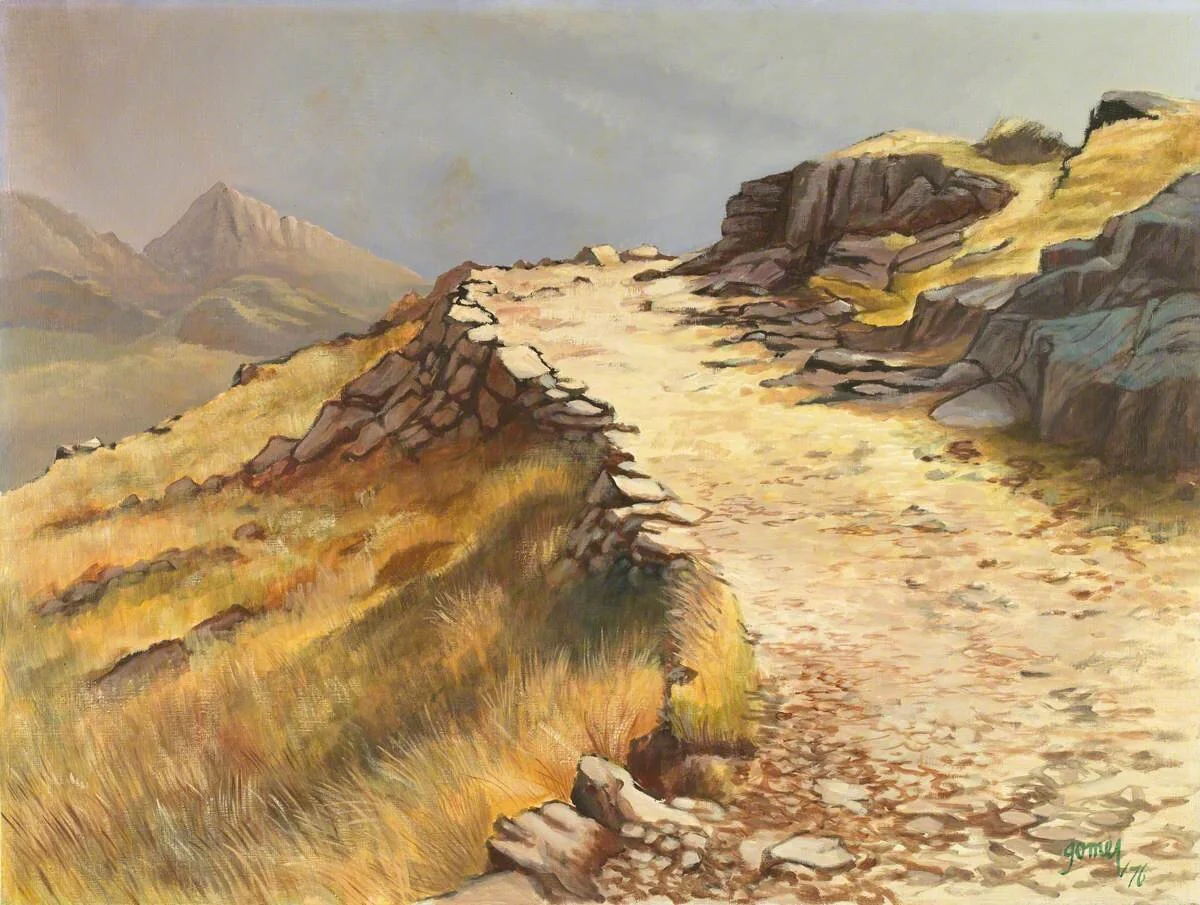
Mountain Path, North Whales by Gomer Lewis
How truly terrifying it must have been for Abraham as he walked up the mountain to follow God’s command and sacrifice his only son on the altar. I can only imagine the questions Abraham was asking the Lord along the journey and the heartbreak of giving up his son, whom he loved.
Yet Abraham trusted the Lord! He knew that God would provide a way. Even when Isaac asks where the lamb is, Abraham replies,
“God himself will provide the lamb.” -Genesis 22:8
He knew that he could put his trust in God’s love, so he willingly placed his son on the altar.
And the Lord did provide! Not only in providing a ram in replacement for Isaac, but ultimately in providing Jesus Christ in replacement for us.
“My body will rest secure, because you will Not Abandon Me!” -Psalm 16: 10
Sometimes it is truly terrifying to follow Christ and obey his commands. It means denying the things of this world and walking a path full of challenges and roadblocks. But Paul would go on to remind us,
“If God is for us, who can be against us? He who did not spare his own Son, but gave him up for us all.” -Romans 8: 31-32
Therefore,
Nothing, “will be able to separate us from the love of God that is in Christ Jesus our Lord.” -Romans 8: 39
So we too must be willing to lay down our own flesh and bones, the things we cherish most, and trust in the Lord. During this lenten season, we are reminded of Jesus’s command to
“Deny themselves and take up their cross and follow me!” -Mark 8: 34
While this call may seem daunting, we can rest secure because God will provide! He will not abandon us. For nothing can separate us from the love of Christ! Therefore, we can take up our crosses and follow him!
Heather Endicott is a Greenville native and member of the Village Family. She is currently serving as a missionary teacher at the International Christian School of Budapest working with missionary and third culture kids living in Budapest, Hungary. When she isn’t teaching, she enjoys singing as much as possible.
Lent Day 11
by Cameron Hepola
Genesis 9:8-17, “Then God said to Noah and to his sons with him, “Behold, I establish my covenant with you and your offspring after you, and with every living creature that is with you, the birds, the livestock, and every beast of the earth with you, as many as came out of the ark; it is for every beast of the earth. I establish my covenant with you, that never again shall all flesh be cut off by the waters of the flood, and never again shall there be a flood to destroy the earth.” And God said, “This is the sign of the covenant that I make between me and you and every living creature that is with you, for all future generations: I have set my bow in the cloud, and it shall be a sign of the covenant between me and the earth. When I bring clouds over the earth and the bow is seen in the clouds, I will remember my covenant that is between me and you and every living creature of all flesh. And the waters shall never again become a flood to destroy all flesh. When the bow is in the clouds, I will see it and remember the everlasting covenant between God and every living creature of all flesh that is on the earth.” God said to Noah, “This is the sign of the covenant that I have established between me and all flesh that is on the earth.
Psalm 25:3-9
Indeed, none who wait for you shall be put to shame;
they shall be ashamed who are wantonly treacherous. Make me to know your ways, O Lord;
teach me your paths. Lead me in your truth and teach me,
for you are the God of my salvation;
for you I wait all the day long. Remember your mercy, O Lord, and your steadfast love,
for they have been from of old.
Remember not the sins of my youth or my transgressions;
according to your steadfast love remember me,
for the sake of your goodness, O Lord! Good and upright is the Lord;
therefore he instructs sinners in the way.
He leads the humble in what is right, and teaches the humble his way.
1 Peter 3:18-22, For Christ also suffered once for sins, the righteous for the unrighteous, that he might bring us to God, being put to death in the flesh but made alive in the spirit, in which he went and proclaimed to the spirits in prison, because they formerly did not obey, when God's patience waited in the days of Noah, while the ark was being prepared, in which a few, that is, eight persons, were brought safely through water. Baptism, which corresponds to this, now saves you, not as a removal of dirt from the body but as an appeal to God for a good conscience, through the resurrection of Jesus Christ, who has gone into heaven and is at the right hand of God, with angels, authorities, and powers having been subjected to him.
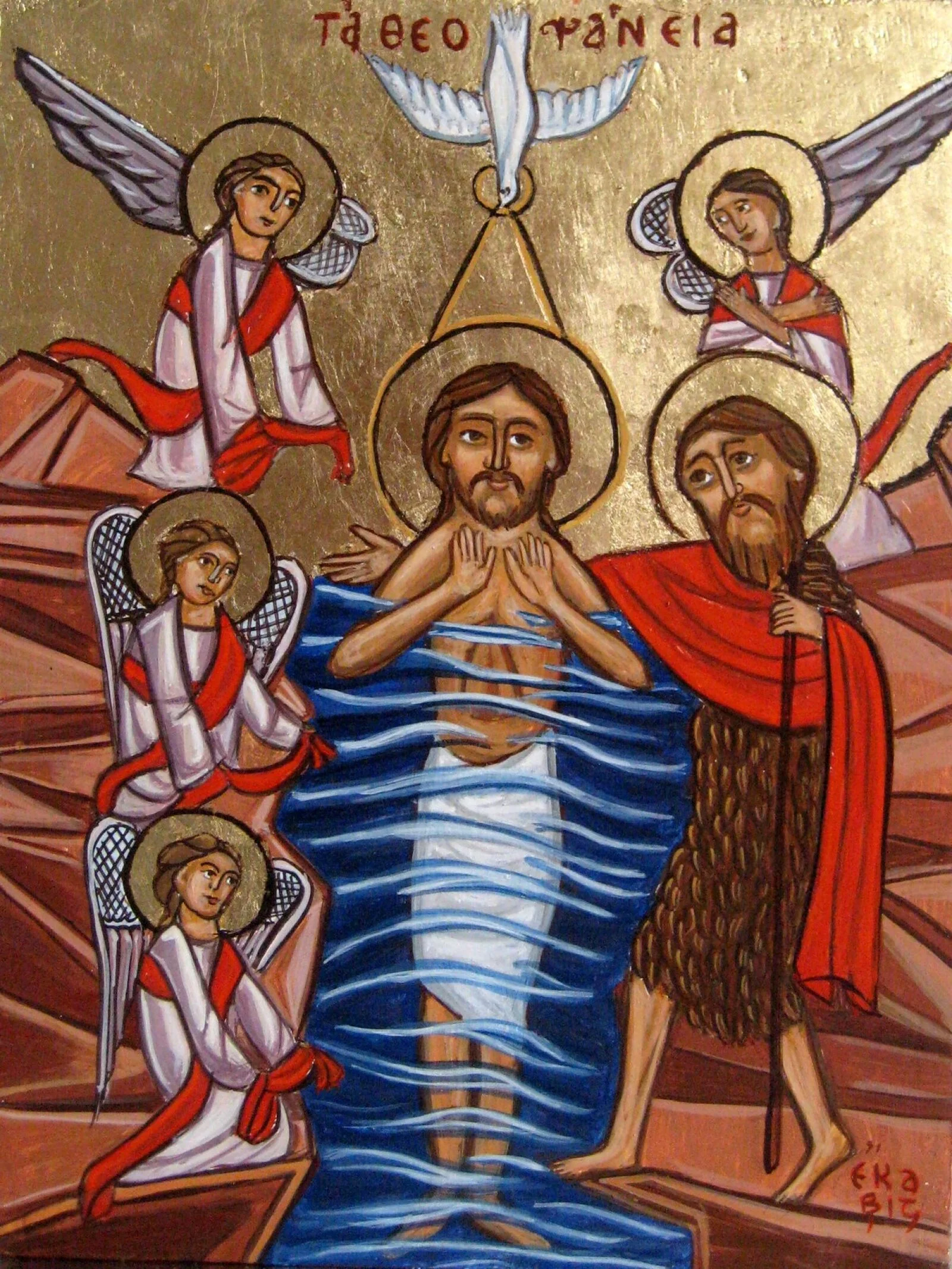
Mark 1:9-13 In those days Jesus came from Nazareth of Galilee and was baptized by John in the Jordan. And when he came up out of the water, immediately he saw the heavens being torn open and the Spirit descending on him like a dove. And a voice came from heaven, “You are my beloved Son; with you I am well pleased.”
The Spirit immediately drove him out into the wilderness. And he was in the wilderness forty days, being tempted by Satan. And he was with the wild animals, and the angels were ministering to him.

In his introductory book to the Old Testament, Harvard Divinity School professor Michael David Coogan writes that in the Hebrew Bible, the number forty is often used for time periods which “separate two distinct epochs.” Whether it is the forty days and forty nights of Noah’s family on the ark, the forty years of the Israelites wandering in the wilderness, or Jesus being tempted in the wilderness by Satan for forty days, the number seems to have a particular significance in the Christian Scriptures. However, according to Coogan, the use of the number forty as a span of time separates events into a “before” and an “after.” Therefore, the forty days and nights spent on the ark separates the before of the profound wickedness of mankind from the after of the rebooting of creation with Noah, the new Adam. The forty years of the wilderness wanderings separates the before of the Israelites languishing in slavery in Egypt from the after of the new generation entering the Promised Land. Lastly, the forty days that Jesus spends in the wilderness being tempted by Satan separates the before of His baptism in the Jordan from the after of His ministry.
Similarly, the forty days of Lent separate the prior epoch of humanity’s enslavement to the powers of Sin and Death to the subsequent epoch of the liberating work of Christ in His cross and resurrection. Moreover, Peter writes that baptism, symbolized by the ark of Noah, corresponds to this passing from one period of time into another. To use Pauline language, baptism is the event that separates the before of the old self from the after of walking in newness of life.
Let us be reminded as we journey through this forty day season that not only do angels minister to us as they did to the Lord Christ but those angels, as Peter says, are subjected to Him as He sits at the right hand of God interceding for us. Let us be reminded that God the Father rescued us from the domain of darkness (the before) and transferred us to the kingdom of His beloved Son (the after). Let us be reminded of the Spirit who descended in the form of a dove upon Christ and, like the dove Noah sent out, is a sign of the promise that we have passed from the old age into the new age.
Cameron Hepola is a Bible teacher at First Presbyterian Academy in Greenville, SC. A member of Village since January 2020, Cameron can be found enjoying coffee or wine, reading a theology book, or watching sports when not teaching.

Lent Day 10
by Jessica Compton
Genesis 9:8-17 And God said, “This is the sign of the covenant that I make between me and you and every living creature that is with you, for all future generations: I have set my bow in the cloud, and it shall be a sign of the covenant between me and the earth. When I bring clouds over the earth and the bow is seen in the clouds, I will remember my covenant that is between me and you and every living creature of all flesh. And the waters shall never again become a flood to destroy all flesh. When the bow is in the clouds, I will see it and remember the everlasting covenant between God and every living creature of all flesh that is on the earth.” God said to Noah, “This is the sign of the covenant that I have established between me and all flesh that is on the earth.
1 Peter 3:18-22, For Christ also suffered once for sins, the righteous for the unrighteous, that he might bring us to God, being put to death in the flesh but made alive in the spirit, in which he went and proclaimed to the spirits in prison, because they formerly did not obey, when God's patience waited in the days of Noah, while the ark was being prepared, in which a few, that is, eight persons, were brought safely through water. Baptism, which corresponds to this, now saves you, not as a removal of dirt from the body but as an appeal to God for a good conscience, through the resurrection of Jesus Christ, who has gone into heaven and is at the right hand of God, with angels, authorities, and powers having been subjected to him.
Mark 1:9-13 In those days Jesus came from Nazareth of Galilee and was baptized by John in the Jordan. And when he came up out of the water, immediately he saw the heavens being torn open and the Spirit descending on him like a dove. And a voice came from heaven, “You are my beloved Son; with you I am well pleased.”
The Spirit immediately drove him out into the wilderness. And he was in the wilderness forty days, being tempted by Satan. And he was with the wild animals, and the angels were ministering to him.

Baptism has always been a curious sacrament to me. Whether it’s an infancy water sprinkling or an ocean submersion, I can’t help but wonder... are we really changed? “You are sealed by the Holy Spirit in baptism and marked as Christ’s own forever,” the priest pronounces. In a physical sense, it is “just water.” Sacraments, however, are “outward and visible signs of an inward and spiritual grace.” Today’s passages weave together God’s story of suffering and redemption, symbolized and pronounced most clearly through baptism.
In Noah and the flood, God invokes disaster, followed by a covenant of mercy and a foreshadowing of baptism. “The Lord shut him in” to the ark for forty days. Though life-saving, it couldn’t have been very fun to be cramped in a small boat with a lot of potent animal smells, surely battling queasy seasickness. The flood is a means to save Noah and his family, but it didn’t come without a willingness to obey God and endure the world’s destruction. Additionally, in God’s promise to never wipe out the earth again, we also have a whisper of his future rescue plan to save us.
Peter expounds on the flood, explaining its correlation to baptism. Just as Noah and his family were brought safely through the flood, we are promised that Christ’s blood washes us of our sins and brings us into God’s family. As Noah and his family suffered in the ark, and Christ suffered on the cross, we will suffer for righteousness’ sake.
Jesus modeled baptism for us, too. Though free of sin, through his baptism, Christ shares his righteousness with us and says: “Let me take your place. I will be for you the Lamb who takes away your sin.” It’s noteworthy that the manifestation of the trinity following Jesus’ baptism in the Jordan is not the beginning of Jesus’ ministry, but the prelude to forty days of fasting and temptation in the wilderness. Paralleling the Lord shutting Noah in the ark, “the Spirit immediately drove [Jesus] out into the wilderness.”
Our Lenten forty days mirror Jesus’ wilderness anguish and ultimate crucifixion. We fast to face temptation, to remember Christ’s sacrifice, and to call on his power in resisting. Having been baptized by both water and the Spirit just as he was, our prayer is to be alive in the Holy Spirit, allowing him to bring us into our own deserts of spiritual discipline. In expecting suffering, we can also trust Peter’s assurance. Baptized and taking on temporary pains for eternal glory, we, like Jesus, are called beloved children of the most high, with whom the Lord is also well pleased.
Jessica’s favorite places to be with Jesus are on a mountain trail or in the saddle of a bicycle, amidst the fellowship of community and corporate worship, and in the secret place of prayer and scripture study. Village became her church family when she moved to Greenville in 2017, and she has enjoyed living into the rhythms of liturgy and the church calendar celebrated in Anglicanism. She loves serving as a Youth volunteer as well as fixing bikes and making friends as Program Director of Village Wrench.
Lent Day 9
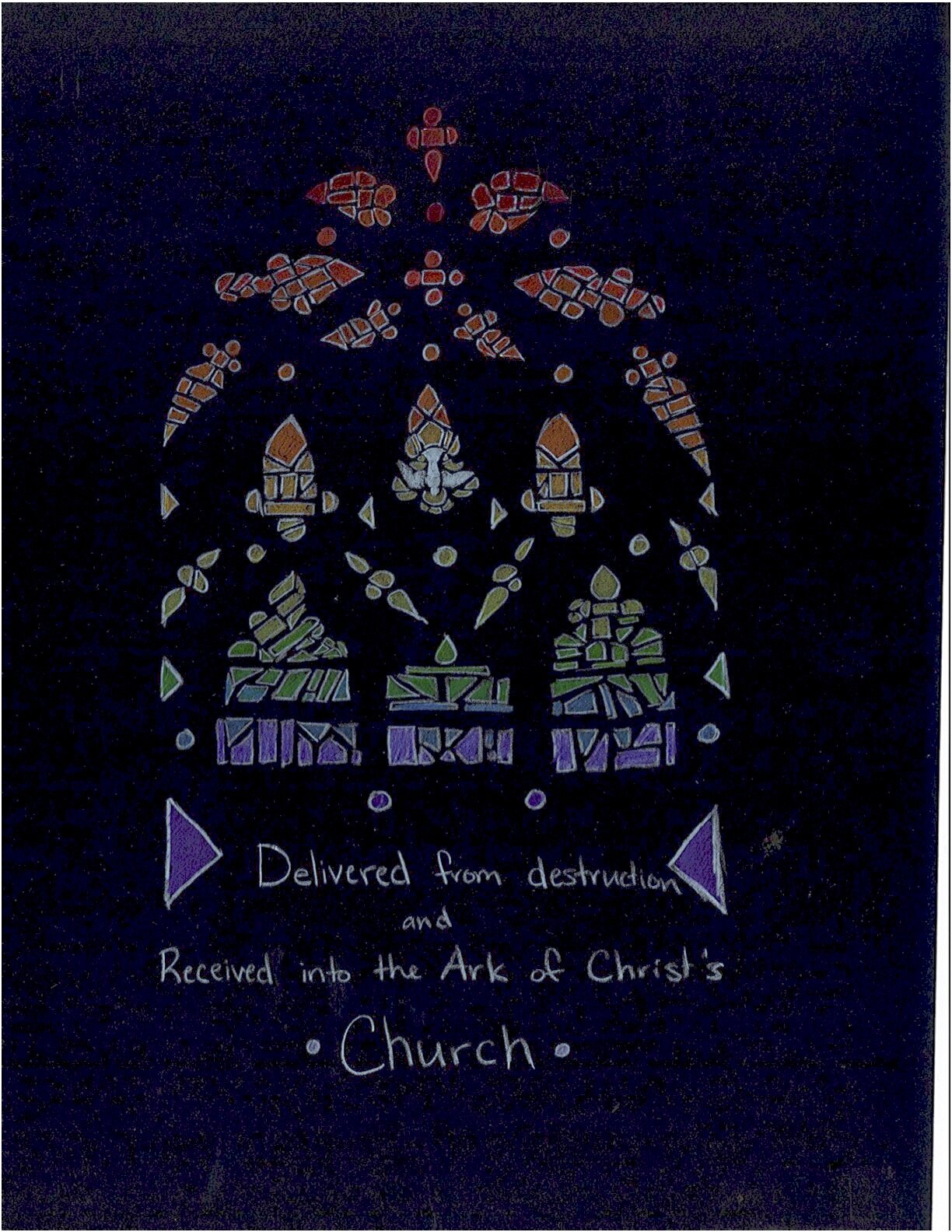
by Rachel Palm, with art by Gracie Gould
Genesis 9:12-17, And God said, “This is the sign of the covenant that I make between me and you and every living creature that is with you, for all future generations: I have set my bow in the cloud, and it shall be a sign of the covenant between me and the earth. When I bring clouds over the earth and the bow is seen in the clouds, I will remember my covenant that is between me and you and every living creature of all flesh. And the waters shall never again become a flood to destroy all flesh. When the bow is in the clouds, I will see it and remember the everlasting covenant between God and every living creature of all flesh that is on the earth.” God said to Noah, “This is the sign of the covenant that I have established between me and all flesh that is on the earth.”

The Rainbow by Gracie Gould
Between Me and you,
After the storm and unending night,
A promise unfurls.
Its colors are wild and true.
I will cover you with my blood.
Drink of my crimson wine; taste my love
Flowing pure and unmeasured.
I will set you free from every chain.
My Spirit’s fire burns orange and hot,
Melting away all fear and impurity.
I will anoint you with joy in the desert,
Golden oil of gladness pouring down to heal
All the wounds and illnesses you carry.
I will plant mercy with you, vast fields
Growing green beneath our shared labor.
Resurrection shall mark your days, not death.
I will lead you through the vast unknowns;
The waters, wide and azure, shall not drown you;
My Light is your compass, anchor, and harbor.
I will make you my royal people,
A priesthood clad in deepest violet,
Flesh and Word bound up with love.
Between Me and you,
A promise of peace unfurls,
Bending its way through the storm,
My banner of love over you.
Prayer: Blessed are You, Lord our God, Ruler of the Universe, who remembers the covenant, who is faithful always, and who keeps His promises.
Gracie Gould is a choreographer and dancer teacher working with The Logos Theatre in Taylors, SC. She is passionate about using the arts to communicate the message of the hope found in Jesus to a broken world. Hobbies include adventures with her loving hubby, gardening, crafts, and naps.
Rachel Palm is a piano teacher and blogger living in Greenville, SC. She is also a big fan of Gracie Gould and finds her work to be very inspiring. She loves seeing words, music, and art nourish the people of God. When she isn’t playing the piano, she enjoys finding a trail to hike with her friends, or writing fantasy stories.
Lent Day 8
by Tracy Balzer
Psalm 25:3-5
No one who hopes in you
will ever be put to shame,
but shame will come on those
who are treacherous without cause.
Show me your ways, Lord,
teach me your paths.
Guide me in your truth and teach me,
for you are God my Savior,
and my hope is in you all day long.
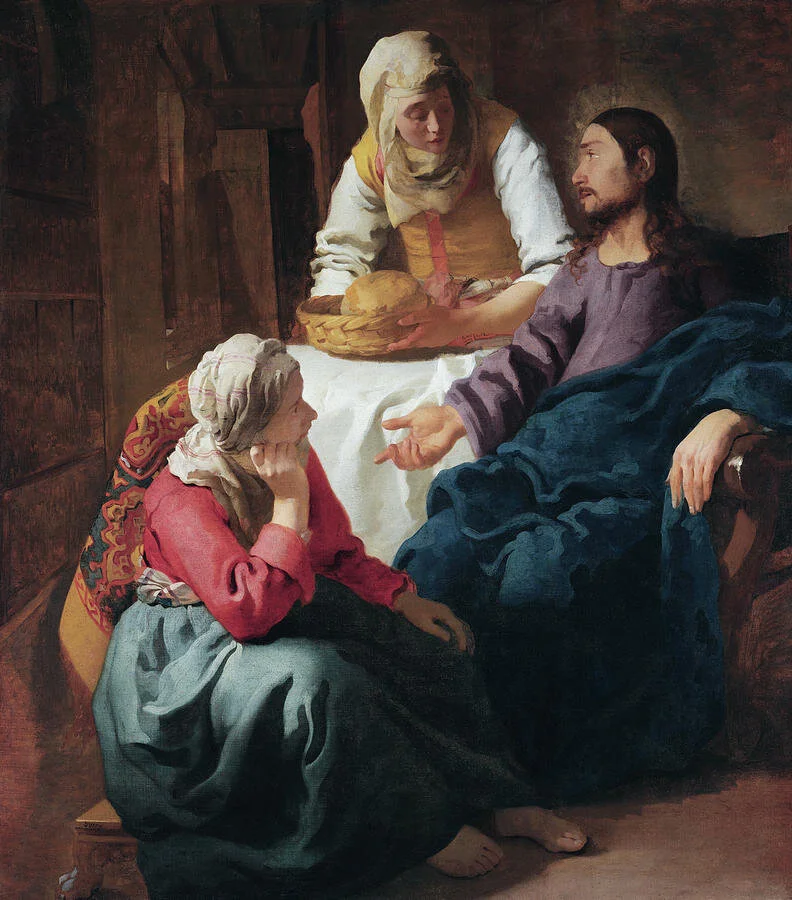
Christ in the House of Mary and Martha by Johannes Vermeer
To be in the physical presence of Jesus must have been remarkable. Seeing him do miracles, watching him take on the religious elite, witnessing him teaching as “one who had authority” (Mark 1:22). There’s no way one could have walked away from any of these big events feeling neutral about Jesus. You’d either be amazed or suspicious. Inspired or irritated. Captivated or turned off.
But there were also very ordinary times in the human life of this extraordinary man. What was it like to be around Jesus when it was time to eat, or sleep, or catch fish or care for family needs or wash clothes? Was Jesus only intriguing when he was doing something spectacular?
Vermeer’s painting of Christ in the House of Martha and Mary illustrates the familiar story of a very ordinary moment. Jesus was visiting his good friends in their home in the village of Bethany. In Luke’s telling of this story, we have two sisters – one who is “worried and upset about many things” (Martha) and the other who has “chosen what is better” (Mary). She chose to give her attention to the visually unspectacular but transformative wisdom and truth of Jesus.
The daily external pressure of duty demands for attention and coaxes us into deep levels of anxiety. I believe this is what Martha may have been experiencing here; I recognize it as something I struggle with myself. The external and internal realities are always doing battle. Jesus – the Word made flesh – shows us that the internal and external do not have to wage war but rather can coexist. Yes, life is meaningful because of our work, our responsibilities, the tangible nature of things. But it is an incomplete meaning without receiving “what is better” – the wisdom and presence of Christ.
We are faced with a choice each day. Will we only be attentive to Jesus when he is doing something obvious, spectacular? Or can we adopt Mary’s posture and take in his wisdom in the ordinary moments of the day as well? Can I choose the Psalm-writer’s prayer of simple desire: “Show me your ways, Lord, teach me your paths. Guide me in your truth and teach me, for you are God my Savior, and my hope is in you all day long.”
Imagine yourself sitting with Jesus, listening, as if the notes played in this piano piece are Christ’s words to you. What is he teaching you? Some things are hard. Some things are encouraging. Some things are beautiful. Some things are mysterious. Some things are comforting.
Listen.
Tracy Balzer is the author of Thin Places: An Evangelical Journey Into Celtic Christianity (Leafwood); A Listening Life (Pinyon); and Permission to Ponder: Contemplative Wisdom for the Spiritually Distracted (Leafwood. In her own spare time, she is an avid calligrapher with a passion for all things ink and paper, and loves discussing movies and pop culture with an eye for creative and redemptive spiritual truth. She also hosts a fabulous podcast called A Listening Life.
Tracy is married to Cary, and they live in Siloam Springs, Arkansas. She has served as director of Christian Formation and assistant professor at John Brown University for the last 25 years.