

Desmós
Stories, prayers, musings and other creative inspiration
to strengthen the BOND at Village Church.

Lent Day 7
by Jewel Gilbert
Genesis 9:8-17, I establish my covenant with you, that never again shall all flesh be cut off by the waters of the flood, and never again shall there be a flood to destroy the earth.”
Psalm 25:3-9
Remember your mercy, O Lord, and your steadfast love,
for they have been from of old.
Remember not the sins of my youth or my transgressions;
according to your steadfast love remember me,
for the sake of your goodness, O Lord!
1 Peter 3:18-22, For Christ also suffered once for sins, the righteous for the unrighteous, that he might bring us to God, being put to death in the flesh but made alive in the spirit, in which he went and proclaimed to the spirits in prison, because they formerly did not obey, when God's patience waited in the days of Noah, while the ark was being prepared, in which a few, that is, eight persons, were brought safely through water. Baptism, which corresponds to this, now saves you, not as a removal of dirt from the body but as an appeal to God for a good conscience, through the resurrection of Jesus Christ, who has gone into heaven and is at the right hand of God, with angels, authorities, and powers having been subjected to him.
Mark 1:9-13 The Spirit immediately drove him out into the wilderness. And he was in the wilderness forty days, being tempted by Satan. And he was with the wild animals, and the angels were ministering to him.

“In the dark times, will there be singing?
Yes, there will be singing.
About the dark times.” - Bertolt Brecht
Let not the veneer of familiarity distort your vision as you read the passages for this week. They cover dark and difficult times. To review:
A massive flood drowns every teenager, grandmother, and bouncing bunny outside of the ark. Noah and his family emerge to see a brilliant rainbow in the sky and thousands of bloated, rotting carcasses on the ground.
The psalmist desperately tries to make sense of a world that feels unjust and overwhelming. He pours this desperation into a song, which appears to have no heavenly response.
Over the course of six weeks, Jesus starves, faces the literal devil, and finds out that a corrupt politician has imprisoned his cousin out of spite.
Viewing these stories from this dismal lens is a deliberate choice on my part. I am purposefully refusing to see that familiar throughline of waters-parting, dove-descending, choir-singing joyfulness.
To interpret these stories by their darkest elements, however, allows me to see how familiar they are. They feel like my own day and time, where:
A disease has turned so many people into corpses so quickly that our nation has repeatedly faced body bag shortages.
The new president has repeatedly and desperately called for unity, but true unity in politics seems impossible to imagine.
The US has the largest prison population in the world, and nearly half a million of the people imprisoned here have not even had a trial yet.
This is not the only way to view these times. I could instead focus on the incredible teamwork of scientists around the world in developing vaccines, or think about how so many people have adopted pets that shelters are empty in some places.
But I don’t want to rush to those thoughts, and I don’t want to read these passages and only think about rainbows and doves. I find myself wanting to sit with the darkest perspectives, to be patient with the pain, to remember the dark and difficult times long before me.
To trust that God is present in this holy darkness.
Jewel Gilbert works as an Internal Auditor by day and enjoys sleeping at night. In her free time, she is a plant and kitten parent, and occasional crafter. Last year she read 118 books, but feels that the number is a bit misleading given her newfound love of graphic novels and her longtime love of poetry collections.
Lent Day 6
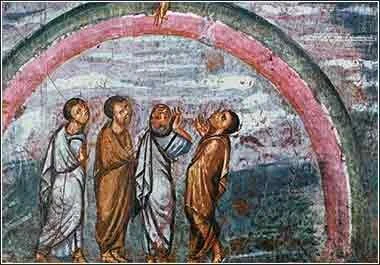
God’s Rainbow by Hannah King
Genesis 9:8-17, “Then God said to Noah and to his sons with him, “Behold, I establish my covenant with you and your offspring after you, and with every living creature that is with you, the birds, the livestock, and every beast of the earth with you, as many as came out of the ark; it is for every beast of the earth. I establish my covenant with you, that never again shall all flesh be cut off by the waters of the flood, and never again shall there be a flood to destroy the earth.” And God said, “This is the sign of the covenant that I make between me and you and every living creature that is with you, for all future generations: I have set my bow in the cloud, and it shall be a sign of the covenant between me and the earth. When I bring clouds over the earth and the bow is seen in the clouds, I will remember my covenant that is between me and you and every living creature of all flesh. And the waters shall never again become a flood to destroy all flesh. When the bow is in the clouds, I will see it and remember the everlasting covenant between God and every living creature of all flesh that is on the earth.” God said to Noah, “This is the sign of the covenant that I have established between me and all flesh that is on the earth.

The story of the flood reminds us of two things. First, the impact of sin is global. Human corruption not only affects the individuals who sin— it has ripple effects to all creation. This challenges our reductionistic, individualistic framework for morality, but it also resonates with our lived experience. Economic and racial disparity, generational patterns of brokenness and addiction, environmental pollution, and political corruption show us that the world is not as it should be. In the flood God responds to sin by washing and cleansing the whole material world.
But the flood story doesn’t only reveal the scope of our problem. It also demonstrates the scope of redemption. God’s judgment is universal, but so is his mercy. After the waters dry up, God makes a promise to all creation. He says to Noah,
“I establish my covenant with you, and your offspring after you, and with every living creature…for every beast of the earth. This is the sign of the covenant that I make, for all future generations: I have set my bow in the cloud, and it shall be a sign of the covenant between me and the earth…the waters shall never again become a flood to destroy all flesh. When the bow is in the clouds. I will see it and remember the everlasting covenant between God and every living creature on the earth.” (Gen. 9:9, 12-16)
Some commentators on this passage describe the “bow in the clouds,” the rainbow, as God’s bow of judgment pointing not down toward earth, but up into the heart of Heaven. This is one way to understand the gospel: God, in Christ, assumes into Himself the judgment due to humanity. In the New Testament, Jesus describes this ministry as his baptism: “Are you able to be baptized with the baptism with which I am baptized?” (Mark 10:38)
Jesus’ passion is a baptism, a cleansing and purgative flood that He endures for the life of the world. In turn, our baptism in His name becomes for us an ark of salvation, through which we are saved from the flood of God’s judgment (1 Peter 3:20-21). Jesus’ baptism—both his literal baptism in the Jordan and his spiritual baptism on the cross—is an immersion into us, so that we can be saved through immersion into him. He has become a part of this world in order to save it.
Link to music: https://carolinecobb.bandcamp.com/track/that-day-2-peter
The Rev. Hannah King is an associate rector at Village Church. She loves words and tries to write, speak, read and share them regularly (some can be found here). She is very fortunate to spend half her time in parish ministry and half of her time at home with her two sons, who teach her important skills like how to fight with a sword and how to throw a paper airplane.
Lent Day 5
by Kim Romig
Genesis 9:8-17, “Then God said to Noah and to his sons with him, “Behold, I establish my covenant with you and your offspring after you, and with every living creature that is with you, the birds, the livestock, and every beast of the earth with you, as many as came out of the ark; it is for every beast of the earth. I establish my covenant with you, that never again shall all flesh be cut off by the waters of the flood, and never again shall there be a flood to destroy the earth.” And God said, “This is the sign of the covenant that I make between me and you and every living creature that is with you, for all future generations: I have set my bow in the cloud, and it shall be a sign of the covenant between me and the earth. When I bring clouds over the earth and the bow is seen in the clouds, I will remember my covenant that is between me and you and every living creature of all flesh. And the waters shall never again become a flood to destroy all flesh. When the bow is in the clouds, I will see it and remember the everlasting covenant between God and every living creature of all flesh that is on the earth.” God said to Noah, “This is the sign of the covenant that I have established between me and all flesh that is on the earth.
Psalm 25:3-9
Indeed, none who wait for you shall be put to shame;
they shall be ashamed who are wantonly treacherous. Make me to know your ways, O Lord;
teach me your paths. Lead me in your truth and teach me,
for you are the God of my salvation;
for you I wait all the day long. Remember your mercy, O Lord, and your steadfast love,
for they have been from of old.
Remember not the sins of my youth or my transgressions;
according to your steadfast love remember me,
for the sake of your goodness, O Lord! Good and upright is the Lord;
therefore he instructs sinners in the way.
He leads the humble in what is right, and teaches the humble his way.
1 Peter 3:18-22, For Christ also suffered once for sins, the righteous for the unrighteous, that he might bring us to God, being put to death in the flesh but made alive in the spirit, in which he went and proclaimed to the spirits in prison, because they formerly did not obey, when God's patience waited in the days of Noah, while the ark was being prepared, in which a few, that is, eight persons, were brought safely through water. Baptism, which corresponds to this, now saves you, not as a removal of dirt from the body but as an appeal to God for a good conscience, through the resurrection of Jesus Christ, who has gone into heaven and is at the right hand of God, with angels, authorities, and powers having been subjected to him.
Mark 1:9-13 In those days Jesus came from Nazareth of Galilee and was baptized by John in the Jordan. And when he came up out of the water, immediately he saw the heavens being torn open and the Spirit descending on him like a dove. And a voice came from heaven, “You are my beloved Son; with you I am well pleased.”
The Spirit immediately drove him out into the wilderness. And he was in the wilderness forty days, being tempted by Satan. And he was with the wild animals, and the angels were ministering to him.

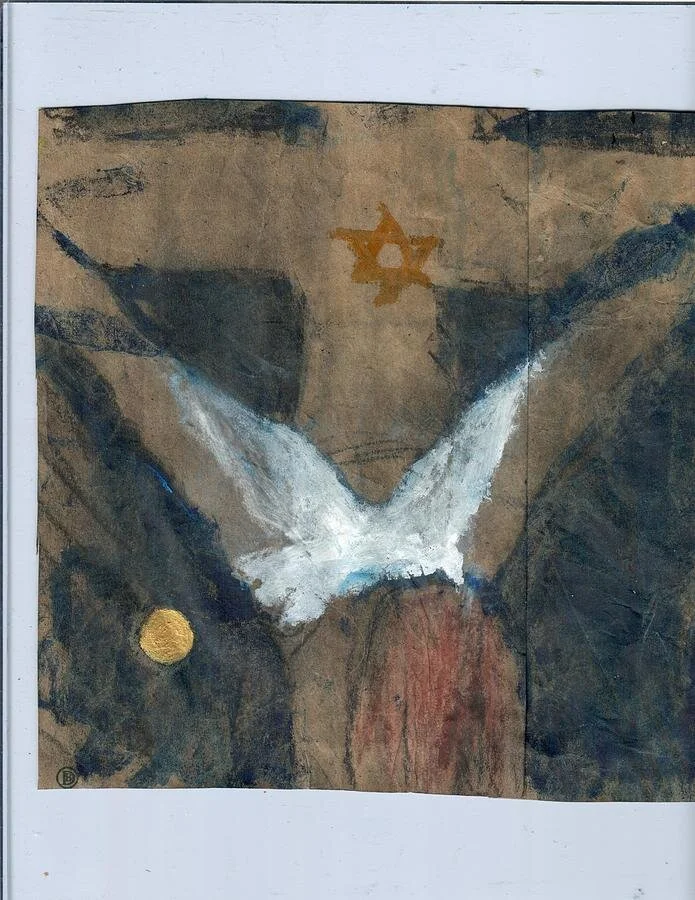
Trinity and the Crucifixion by Daniel Bonnell
We find ourselves in the midst of much suffering, evil, and temptation…as did Noah, David and Jesus in our Scriptures today. They offer us guidance and hope.
Genesis 9 describes God’s unconditional covenant with Noah and all creatures to never again destroy all His creation with a flood of water. This is a story not only of well-deserved judgment & cleansing of evil, but also of God’s great provision and mercy!
O Lord, we need your justice, mercy and provision in these trying times.
Ps. 25 is David’s cry to God for help from his enemies, referencing God’s conditional covenant with Israel (if Israel is faithful to God, He will bless and protect them). David reflects on God’s attributes recalling who this God is to whom He cries. He gains perspective & faith in the process. Take a moment to underline the descriptive words of God in this Psalm, then cry out with David:
Guard my whole being and deliver me. Redeem our country from all its troubles. (see vss. 20-22)
Mark 1 is the story of Christ’s baptism. Mark opens his Gospel not with the birth of Christ, but with Christ’s official “ordination”. “This is my Son in whom I am well pleased” came a voice from heaven (God’s voice often was heard with the establishment of covenants). This marked the beginning of the New Covenant, the unconditional covenant of God’s grace to be poured out through His Son who is the perfect and complete, freely given, sacrifice for our sins. The waters of Baptism here reference the total cleansing of evil that Jesus will accomplish for us, just as the waters of the flood once cleansed the earth of sin. God once again provides a way out, and this one is for all people and all time.
Lord God, thank you for your “once-for-all” provision in Christ that no suffering, evil, or temptation can ever take away from us.
In our final passage, Peter explains further what this “Son of God” accomplished and what our response is to be. Jesus “suffered” as a vicarious sacrifice for our sins to the point that he was “put to death in the flesh”. He patiently endured suffering that led to His death, but then came Resurrection, freeing us from the well-deserved consequences of the evils within us. When Jesus struggled, He cried out to God just as David did in Ps. 25. As Christ-followers, we too are called to suffer for something beyond ourselves.
Almighty Father, empower us to face and overcome the suffering, evil and temptation we encounter, through Jesus Christ our Lord, Amen.
Kim Romig is a follower of Jesus in the Anglican way. She is retired from teaching math, Biblical studies & spiritual formation. She enjoys family & grandchildren, the outdoors, mentoring, and all things with my husband of 43 years.
Lent Day 4
by Bethany Smith
Psalm 103:8-14
The Lord is merciful and gracious,
slow to anger and abounding in steadfast love.
He will not always chide,
nor will he keep his anger forever.
He does not deal with us according to our sins,
nor repay us according to our iniquities.
For as high as the heavens are above the earth,
so great is his steadfast love toward those who fear him;
as far as the east is from the west,
so far does he remove our transgressions from us.
As a father shows compassion to his children,
so the Lord shows compassion to those who fear him.
For he knows our frame;
he remembers that we are dust.

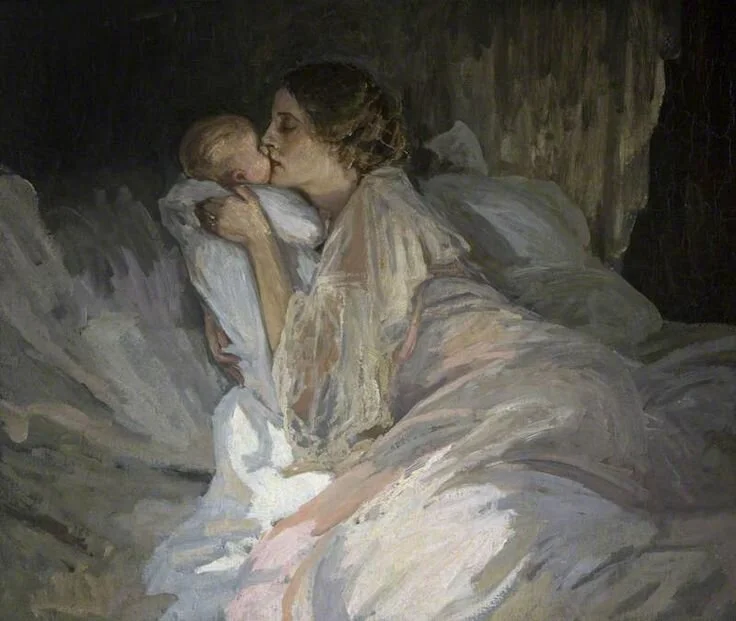
The Mother by Sir John Lavery
As I walked along the seashore, the crisp and salty winter air whooshed across my face, providing a sensation comparable to that first bite of a York peppermint patty. Though it was cold, the beach was still fairly populated with fellow adventurers who were wrapped in their warmest, most water-resistant clothing as they walked their dogs and as young ones galloped in the sand. Walking into a nearby coffee shop, one small child with bright red cheeks, who was wrapped up so well that they wobbled more than walked, curled up next to her mother who tenderly and faithfully snuggled her daughter close to her side to warm her up after their afternoon frolic as they waited for their warm food and afternoon tea…
* * * * * * *
This year has been – well hard. The past eleven months have been painful for many, and lonely for most. We, as a human race, are more aware than we have been in a long time of what it means to be human; of what it means to be frail and mortal. The phrase memento mori has echoed in our cultural mind for months. Receiving ashes this Ash Wednesday and being reminded that, indeed, we are dust and to dust we shall return has a different, more profound impact this year. We have seen almost half a million people die in America alone from one virus. That reality is staggering and excruciating.
The Psalmist reminds us that “The LORD is merciful and gracious” and “as a father has compassion for his children so the LORD has compassion…for he knows how we are made; he remembers that we are dust”. I need to be reminded of God’s compassion, mercy, and love. I need to be reminded that God sees me – sees each of us – as his beloved child, and he is always ready for us to curl up next to him when we are in need. He is compassionate and good.
One of my favorite paintings is Sir. John Lavery’s The Mother. Gracing the walls of the Ulster Museum in Belfast, Northern Ireland, this is a painting I used to rush to see during my monthly visits to the museum when I lived in the city. The painting is an intimate portrayal of a young mother gently and lovingly holding and kissing her infant child. For me, this image depicts the beauty of God’s gentleness and love toward us – God’s children. Seeing God as more than a Father, but also as a loving, gentle, strong, and comforting Mother is a profound source of comfort. This has been particularly true this year.
May you be comforted. May you be a comfort to others. May you remember that you are dust, and may you find comfort in God’s compassionate arms of love.
Bethany Smith has degrees in Conflict Transformation and Social Justice from Queen’s University Belfast and in Higher Education. She currently coordinates campus ministry opportunities at John Brown University, and serves in a variety of capacities in her parish, Grace Episcopal Church in Siloam Springs, Arkansas. She lives with her beloved Welsh Corgi, Artie.
Lent Day 3
by Jenna Badeker
Joel 2:1-2
Blow the trumpet in Zion; sound the alarm on my holy hill.
Let all who live in the land tremble, for the day of the Lord is coming.
It is close at hand— a day of darkness and gloom,
a day of clouds and blackness.
Like dawn spreading across the mountains
a large and mighty army comes,
such as never was in ancient times, nor ever will be in ages to come.
Psalm 103:8-14
The Lord is compassionate and gracious,
slow to anger, abounding in love.
2 Corinthians 6:1-10
God made him who had no sin to be sin for us, so that in him we might become the righteousness of God.
For he says,
“In the time of my favor I heard you,
and in the day of salvation I helped you.”
I tell you, now is the time of God’s favor, now is the day of salvation.
Rather, as servants of God we commend ourselves in every way: in great endurance; in troubles, hardships and distresses; in beatings, imprisonments and riots; in hard work, sleepless nights and hunger; in purity, understanding, patience and kindness; in the Holy Spirit and in sincere love; in truthful speech and in the power of God; with weapons of righteousness in the right hand and in the left; through glory and dishonor, bad report and good report; genuine, yet regarded as impostors; known, yet regarded as unknown; dying, and yet we live on; beaten, and yet not killed; sorrowful, yet always rejoicing; poor, yet making many rich; having nothing, and yet possessing everything.

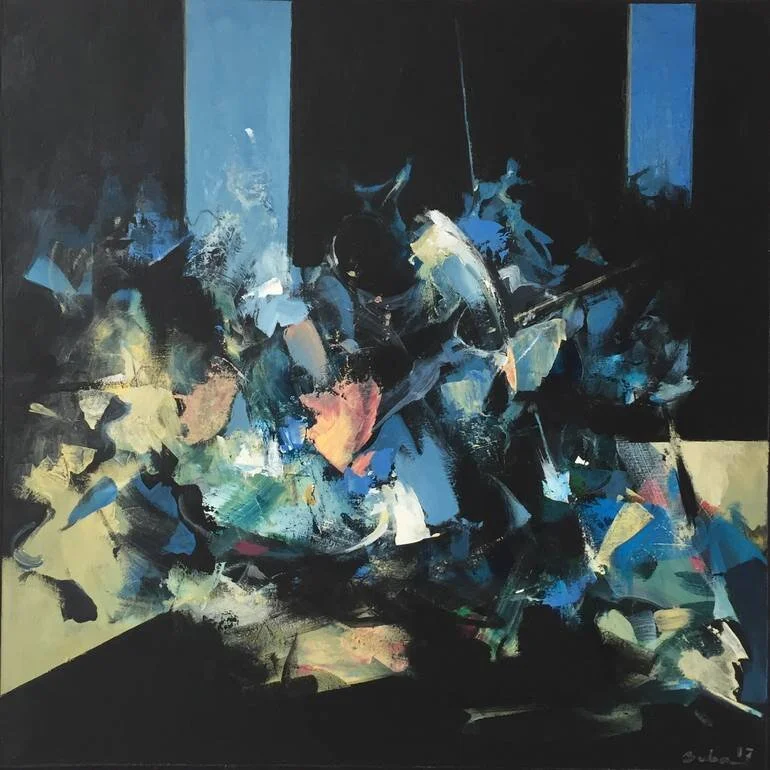
The Army of Shadow by Adrian Buba
Armies in Scripture have different effects on the reader. Sometimes they are a saving force, empowered by the Lord. Other times they decimate what’s in front of them. In Joel, we read of an army coming, but it is hardly “good news of great joy.” The Day of Lord is a dreaded threat as the people have strayed far from the Lord. This army is thought by some to be the swarms of locusts mentioned previously in Joel, while others think it is a force yet to come. Either way, it is dire.
What a juxtaposition with Psalm 108! Here, the same God sending warning of decimating the people is “compassionate and gracious, slow to anger, abounding in love.” It seems like a contradiction. But He is slow to anger - not ‘never angry.’ He is a God of wrath AND a God of compassion and love. The Psalm soothes and balances the warning message of Joel: “He will not always accuse, nor will he harbor his anger forever. He does not treat us as our sins deserve or repay us according to our iniquities.”
What a different time in history we live in. I try to imagine hearing news from God that a great army is coming and feeling dread. In Lent, we practice a fast, the years of silence from God, and the longing for a Savior that his people felt for so long. In our “already, and not yet,” when we are told of an army, we have the gift of salvation in Christ enveloping us in protection and forgiveness and grace. It is an army that will fight for us, defend us, not leave us forsaken. 2 Corinthians reminds us that we are included in the righteousness of God, that “now is the time of God’s favor, the day of salvation.” What an incredible gift.
The army that comes to defend does not absolve us of all hardship. Paul goes on to caution and exhort the Corinthians to dedicate themselves as servants of God in all circumstances, including beatings and sleepless nights and the good and bad alike. It’s as if Paul is urging us to steady ourselves. In this song, that is the cry - “steady now, and steady on.” We press on into this season of darkness, toward the precious blood of Christ that gives us hope of a new season to come.
Jenna Badeker is a singer-songwriter from Nashville, TN. She writes and performs in the band Wild Harbors with her husband, Chris. She also leads musical worship, guest blogs for The Rabbit Room, teaches vocal lessons, and spends time delighting in her two pet bunnies. Find more of her work at www.wildharbors.com.
Lent Day 2
by Will Gray
Joel 2:1-2
Blow a trumpet in Zion;
sound an alarm on my holy mountain!
Let all the inhabitants of the land tremble,
for the day of the Lord is coming; it is near,
2 a day of darkness and gloom,
a day of clouds and thick darkness!
Like blackness there is spread upon the mountains
a great and powerful people;
their like has never been before,
nor will be again after them
through the years of all generations.

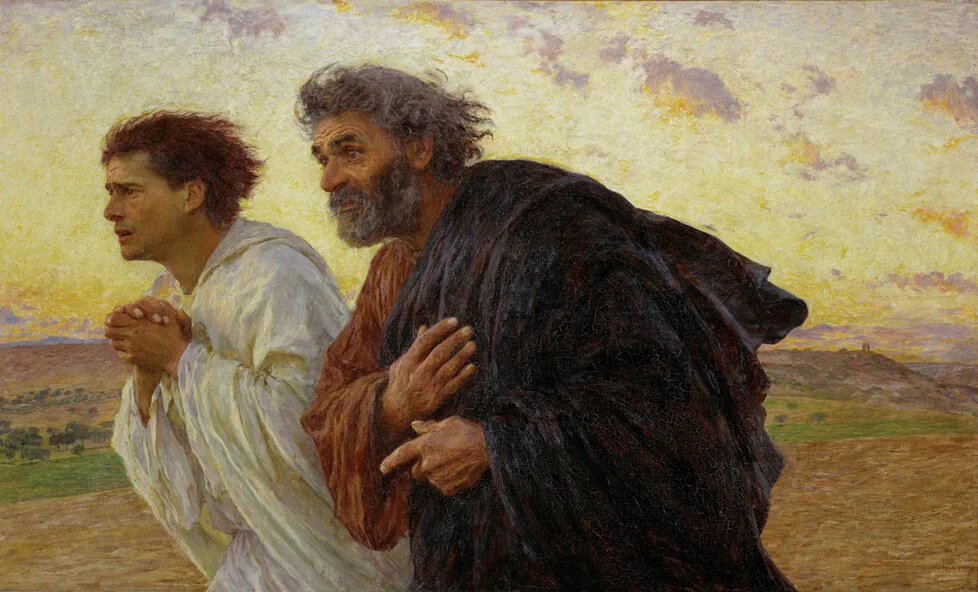
The Disciples Peter and John Running to Tomb by Eugène Burnand
I was barely teenaged when I learned that color exists only because of light.
As a child, I had experienced the kaleidoscopic dimmer switch called “sunset,” but I must have thought—as the color slowly drained from the day—that it was simply too dark to see the colors anymore.
I was wrong.
Color isn’t easier to see after sunrise. It doesn’t exist until sunrise. Blues, yellows, magentas and sages all bloom into being only after sunlight shines onto the world, after everything in its gaze absorbs and reflects a dose of its rays. The result of that tinctured conversation between light and each thing is . . . color.
I thought of that rainbowed dialogue as Lent waved from over the wintry-dark hill we call New Year’s Day. I thought of it when my two-year-old son cried after the sun “went away,” and we had to remind him that other people need it to visit them too.
I thought of it because of Joel 2, a terrifying Lent passage where the day of the Lord isn’t really a day at all but the night-time darkness of his absence.
There’s terror in this darkness, because it means creation in reverse. It means that all the color and happiness is drained from the world of those who disconnect themselves from God.
It’s easy to forget that we’re never truly threatened by the presence of God. It’s his absence that maroons us in the darkness, and his arrival that’s a gift.
During Lent, we remember more than the murkiness of a world gone astray, more than the line between light and dark running through our hearts. We remember the One who entered the darkness for us, both the palpable dread of the garden and the daytime gloom of the crucifixion. He did it for us, you know. He did it for everyone who would join the family that the Lord makes his face to shine on.
In the next life, there will be no need of the sun. The presence of God himself will blossom us into our technicolor True Selves for good.
For now, in these years of in-between, we remember where our hope, our definition come from. There will be seasons of darkness, of not-seeing-why, of suffering. These seasons are teaching us to long for . . . even to pre appreciate . . . what happens when the light finally arrives.
Will Gray helps people and organizations discover who they’re made to be, through his companies ALIGN and Vocationality. He is husband to Alison, father to Eden, Vincent, and Sydney, and grateful recipient of a PhD from the University of St Andrews.

Ash Wednesday
by Rachel Palm

Dust you are, and to dust you will return.
During those first few weeks of pandemic and quarantine, I watched the sunset near my house almost every evening. There was a palpable sense of loss each time the sun sank behind the trees. Light, all gone. Darkness, ever present.
But I kept watching church services, kept listening to the Word, and kept trying to make music, even when it felt like the world was going to stop spinning. Why? Because I could hear my friends reciting the Lord’s Prayer over Zoom, and their faith and kindness helped me to believe in the reality of Christ.
This Lent Project is much the same. In this past year, I have not always believed in the goodness of God. I have had nights of worry, and days of exhaustion, wondering if it was really possible for the world to be more crazy than it had been yesterday. The beauty each participant has contributed has fed and encouraged me. Through their meditation on the Word, my friends have reminded me of the fruit that may grow in affliction, of the brightness that exists alongside sadness, and of God’s luminous love shining in the darkness. What hope and joy I myself have brought to this project is due in large part to the faithfulness of friends, and the unending kindness of God. May these words, art pieces, and songs nourish all of our hearts, and help us approach the Word with fresh eyes during this season of repentance.
This day, as you begin Lent, I encourage you to look for where there is brightness alongside your sadness.
Rachel Palm is a piano teacher and blogger living in Greenville, SC. She loves seeing words, music, and art nourish the people of God. When she isn’t playing the piano, she enjoys reading long books, finding a new trail to hike with her friends, or writing fantasy stories.

Recovering Sabbath in Coronatide

Two Sundays ago, I found myself in tears as I was reminded of one of my favorite parts of the Anglican service: the filing down the aisle of people from all ages and walks of life towards the communion table. Hands outstretched. Hearts open before the Lord. For the past several months, we have only been sending one representative from each family to receive the bread, but this change of seeing entire family units make their way forward was so moving for me. Even with six feet between one other, and with masks covering our faces, and with squirming toddlers receiving blessings from a distance, I was reminded how precious it is for each of us to journey towards the table every Sunday. One foot in front of the other.
As Village was able to safely reinstitute this small (but actually big) element of our worship together as a body, I was given the chance to reflect upon other small (but big) elements of our family’s normal Sundays that have gone missing since COVID arrived.
Before COVID, we had a rhythm—as most of us did/do—that helped our family flow through the week, culminating with Sunday, our Sabbath day. It was our day of rest, of play, of only eating left-overs so nobody had to cook, and of leaving out ‘Sabbath Bread’ on Saturday evening so that parents could sleep in before church and the children could do breakfast on their own. Almost all of our family rhythms have drastically shifted since March, and it has taken me until now to stop and examine them.
I realize that as school is starting back, and as we are starting to be involved safely in activities again, our old rhythms are very much in need of reinstating. The most important of these rhythms is Sabbath, as both our ending and our beginning point of the week. It is not only our family’s day of physical rest and enjoyment of each other’s uninterrupted time, but also our filling up with the Body of Christ, and our time of being equipped to go out and ‘do the work (He) have given us to do’.
This blog is both a confession of how I haven’t taken a true Sabbath in months and haven’t prepared my heart well to enter into worship, and it is also a call for myself and others to re-establish a Sabbath. I realize how restless I’ve been over these strange few months of ‘half normal summer’, and I am reminded of St. Augustine’s famous quote: “Thou hast made us for thyself, O Lord, and our heart is restless until it finds its rest in thee.” Of course I’m restless if I haven’t taken a proper day of rest. A day to truly re-member myself to my maker and to truly rest in his tender presence and peace.
As we’ve started to make some adjustments and began to think through some of our former family liturgies, I wanted to share some simple thoughts on how to start a true Sabbath again. There are so many good ideas out there and I’ve only listed a few here to get us going.
-Start on Saturday.
Start on Saturday by mentally and physically preparing yourself and your family for Sabbath. Make some Sabbath Bread* as I mentioned earlier. This could be something fancy or a box of Betty Crocker muffin mix. This is an act of preparation that marks the start of rest on Sunday. The muffins can be left in a Tupperware on the counter so the kids can enjoy them on their own (they will love the independence!), and if there aren’t kids in your home then it can still serves as a sweet and effortless treat to mark the start of this different and holy day. This might also mean doing chores, running errands, and completing any work needed to do over the weekend on Saturday, even if staying up late to do so, in order that Sunday truly is a day of rest.
-Read the Scripture before the service.
One nice thing about COVID worship is having the liturgy emailed out to us a day or two before the service. Print it out and read it alone or as a family on Saturday night or Sunday before church. Or use Lectio Divina, as Seth+ mentioned in an email, as a way to meditate upon the word as you prepare to spend more time with it on Sunday. Or ask your children to listen for a word or phrase, as Sharon recommended, from the text as it is read on Sunday. Or ask yourself or others what words or images mean the most in the passage, and draw a picture to express them.
-Turn off your screen. Full stop.
I know this one is so very hard to do. If at all possible, try not to bring your phone to church or leave it turned off in your car. Try to go the whole morning before church, and even the hour or two after, without turning it on. Worship means offering ourselves to God, and it’s almost impossible to offer our full selves when we are half-connected to our devices.
-Make two lists.
What makes you feel rested and peaceful? Make a list of these things. Does it involve napping, creating, singing, exercising, reading a novel, or baking? Make an effort to do these things on Sundays as acts of worship and restoration. For your second list, keep a note pad out on Sunday and every time you are tempted to order something on Amazon or run over to Home Depot, jot it down so that you can come back to it on another day. It’s not lost, but the urgency is taken from the task and you have that space back to continue resting and worshiping.
-Prepare the family to enter into worship.
I know that this is not as easy as it was a few months ago when we would physically enter into the sanctuary and mark the start of our time together. The baptismal water and the smell of incense really helped stimulate my children’s senses. We don’t have these elements, but we do have the beauty of nature around us, and we have the chance to join our voices with the song of creation, from the cicada’s buzz to the rooster’s crow. I highly recommend the children’s book, Glory, as it has beautiful words and illustrations that connect our bodies with all of creation as we each uniquely sing glory to God. Since it is noisy outside once we arrive at church, possibly having a silent car ride all the way there could be a way of marking the time as holy and helping us prepare to enter in.
As we continue worshipping together outside for the next few months in the gift of the ‘cathedral of trees’, and as our lifestyles continue to be in a bit of flux due to COVID, may we not tarry in our efforts to connect on Sundays and to re-embrace our Sabbaths as days of worship and rest. In a season marked by so much confusion, noise, unrest, and instability, we need to reclaim this time now more than ever.
*This idea and many others can be found in the book: 24/6, by Matthew Sleeth.
Race and the Warden

How a Victorian Novel That Has Nothing Whatever to Do with Race Can Help Us Reckon with Our Own White Privilege
Like many of you, I’ve felt the crushing weight of events this last week, and like many of you, I’ve been struggling to make sense of them in ways that are faithful to the Gospel. My reaction has often been to oscillate between aggressive confrontation of these evils (Facebook posts!) and a retreat to escapism (Netflix!). But oddly enough, I’ve found something of a convergence between these impulses in meditating on a novel I read with my students this spring for my course “Wealth and Poverty in the Christian Tradition,” a course I teach regularly at Furman. And so I thought I’d put pen to paper, so to speak, and share some of these thoughts. Maybe, like me, you’re looking for a break from the oppressive news cycle, and the escapism of some summer reading outside your ordinary literary habits would be welcome (unless you’re already a member of the small but devoted band of Trollopians!). I hope this won’t disappoint, and I hope that it might also help us think a little bit more clearly about what kind of character is required of us in these turbulent times.
I’d like to introduce you to a friend of mine, the Rev. Septimus Harding, precentor of Barchester Cathedral, in the west of England. (A “precentor” is what Victorian Anglicans used to call an ordained clergyman whose job it was to lead the choir; we would call him a worship leader.) But I’m afraid he does not cut an impressive figure at first glance:
“Mr. Harding is a small man, now verging on sixty years, but bearing few signs of age; his hair is rather grizzled, though not grey; his eye is very mild, but clear and, bright, though the double glasses which are held swinging from his hand, unless when fixed upon his nose, show that time has told upon his sight; his hands are delicately white, and both hands and feet are small; he always wears a black frock coat, black knee-breeches, and black gaiters, and somewhat scandalises some of his more hyper-clerical brethren by a black neck handkerchief.”
As I said, not a very imposing figure. Nor can I say that his career has been exactly brilliant, though not without a certain faithful competence in his own way:
“Mr. Harding’s warmest admirers cannot say that he was ever an industrious man; the circumstances of his life have not called on him to be so; and yet he can hardly be called an idler. . . . He has greatly improved the choir of Barchester, which, under his dominion, now rivals that of any cathedral in England. He has taken something more than his fair share in the cathedral services, and has played the violoncello daily to such audiences as he could collect, or, faute de mieux, to no audience at all.”
This description comes from the opening chapter of Anthony Trollope’s short novel, The Warden, published in 1855. The first of six novels chronicling ecclesiastical life in the (alas!) fictitious diocese of Barsetshire in Victorian England, The Warden tells the story of a Church of England clergyman forced to confront the sources of his own wealth and privilege in a time of rapid cultural change. As such, I think his story—and more importantly, his character—speak to our own moment in some pretty direct and powerful ways. But first, I need to say a bit more about Mr. Harding’s dilemma.
In addition to leading worship at the cathedral, Mr. Harding was also appointed, some years back, as the warden of Hiram’s Hospital, an almshouse established in the fifteenth century for the care of impoverished retirees from the local wool-working trade. John Hiram, whose generosity first endowed the hospital with lands and capital for its ongoing support, had specified in his will that twelve bedesmen should be granted free room and board, as well as a small fixed income from the endowment to cover their miscellaneous expenses. The remainder of the proceeds from the endowment should then be used to support a resident clergyman, who would attend to the physical and spiritual needs of his wards.
Over the four centuries following John Hiram’s death, the value of the property he left to the hospital grew beyond his wildest dreams, with the result that the wardenship of the hospital has become one of the most valuable preferments in the west of England. At the time Mr. Harding was granted the position by his dear friend, the Bishop, he was earning a mere £80 per year as a precentor at the cathedral. The wardenship, however, granted him free lodging in a spacious home attached to the hospital, as well as the fabulous income of £800 per year. To put that in terms of current value, an income of £80 might be roughly equivalent to an annual salary of $60,000 in today’s dollars—a living wage, to be sure, though hardly ostentatious for a man supporting two daughters. An income of £880—the duties of the warden not being so demanding as to prevent Mr. Harding from faithfully carrying those of precentor at the same time—would amount to an annual income of more than $700,000 a year today.
Mr. Harding, we are told, never sought this position—indeed he tried to talk the Bishop out of the appointment when it was first offered him. And there is every indication that he has handled his newfound wealth with grace and humility, attending to the needs of his bedesmen with great devotion and even voluntarily increasing their meager allowance from his own ample funds. Indeed, Mr. Harding is such a kind-hearted, gentle soul, that even though the occasional whisper is heard in town questioning whether John Hiram’s will is really being executed according to its founder’s intent, most of the townsfolk are unwilling to trouble Mr. Harding’s conscience on the matter.
Except, that is, for John Bold. A surgeon by training, in reality Mr. Bold is what was called in the nineteenth century a “reformer;” today, we might call him a “social justice warrior.” Consider the following description:
“John Bold is a clever man, and would, with practice, be a clever surgeon; but he has got quite into another line of life. Having enough to live on, he has not been forced to work for bread; he has declined to subject himself to what he calls the drudgery of the profession, by which, I believe, he means the general work of a practising surgeon; and has found other employment. . . . His passion is the reform of all abuses; state abuses, church abuses, corporation abuses (he has got himself elected a town councillor of Barchester, and has so worried three consecutive mayors, that it became somewhat difficult to find a fourth), abuses in medical practice, and general abuses in the world at large. Bold is thoroughly sincere in his patriotic endeavours to mend mankind, and there is something to be admired in the energy with which he devotes himself to remedying evil and stopping injustice; but I fear that he is too much imbued with the idea that he has a special mission for reforming. It would be well if one so young had a little more diffidence himself, and more trust in the honest purposes of others—if he could be brought to believe that old customs need not necessarily be evil, and that changes may possibly be dangerous; but no, Bold has all the ardour and all the self-assurance of a Danton, and hurls his anathemas against time-honoured practices with the violence of a French Jacobin.”
Mr. Bold—who, I must also add, is in love with Mr. Harding’s youngest daughter, Eleanor—has taken it into his head that Mr. Harding cannot in justice be entitled to so vast a sum as £880 per annum from the proceeds of a charitable endowment, and he has launched a campaign to reform the institution and effect a more equitable distribution of its proceeds. This he has done by hiring attorneys to launch a legal investigation (at his own expense), while at the same time drumming up public outrage in the press against the established church and its vampire-like predations on the poor. In so doing, Mr. Bold has made it clear that he intends no aspersions on Mr. Harding’s character—indeed, Mr. Bold holds him in the highest personal esteem, and despite being at odds with him over this matter, hopes soon to claim him as a father-in-law. However, matters have spiraled out of control and gone viral, so to speak: Mr. Bold’s campaign has caught the attention of the editors at The Jupiter, and now poor Mr. Harding is mortified to have become the object of derision for some 100,000 readers of England’s most powerful tabloid.
But Mr. Harding is not without his defenders. Chief among these is his son-in-law, the Rev. Theophilus Grantly, Archdeacon of Barchester and Rector of Plumstead Episcopi—
“…a fitting impersonation of the church militant here on earth; his shovel hat, large, new, and well-pronounced, a churchman’s hat in every inch, declared the profession as plainly as does the Quaker’s broad brim; his heavy eyebrow, large, open eyes, and full mouth and chin expressed the solidity of his order; the broad chest, amply covered with fine cloth, told how well to do was his estate; one hand ensconced within his pocket, evinced the practical hold which our mother church keeps on her temporal possessions; and the other, loose for action, was ready to fight if need be for her defense; and, below these, the decorous breeches and neat black gaiters showing so admirably that well-turned leg, betokened the decency, the outward beauty, and grace of our church establishment.”
With so doughty a culture warrior at his side, Mr. Harding should have no fear from the likes of John Bold or The Jupiter. And indeed, despite the occasional amusement one must feel at the Archdeacon’s pomposity and self-importance, one cannot help but admire his determination and sheer competence in defending the Church’s interests. I don’t want to give too many spoilers, but it is critical to my thesis to observe that Archdeacon Grantly is ultimately successful driving Mr. Bold and his supporters from the field. No less a personage than Sir Abraham Haphazard, the Attourney General himself, renders the infallible view that Mr. Bold’s grievance is utterly without legal basis, and indeed, Mr. Bold has no legal standing to question the Church’s administration of its own funds.
With this bare outline before us, one might think that Mr. Harding would justly exult in his vindication: a decisive victory in the inns at court, as well as in the court of public opinion; his tormentor vanquished, humbly begging his (and his daughter’s) pardon; his friends, family, and professional colleagues all rallying to his defense. And yet, Mr. Harding is uneasy in his conscience. More than uneasy, in fact: despite the unqualified support of the law, his family, and his profession, he has come to conclusion that he cannot justly keep the wardenship. Here is how he announces his intention to the incredulous Attourney General, to renounce his benefice:
Sir Abraham listened in pitying wonder. “I really think, Mr. Harding, you had better wait for the archdeacon. This is a most serious step—one for which, in my opinion, there is not the slightest necessity; and, as you have done me the honour of asking my advice, I must implore you to do nothing without the approval of your friends. A man is never the best judge of his own position.”
“A man is the best judge of what he feels himself. I’d sooner beg my bread till my death than read such another article as those two that have appeared [in The Jupiter], and feel, as I do, that the writer has truth on his side.”
“Have you not a daughter, Mr. Harding—an unmarried daughter?”
“I have,” said he, now standing also, but still playing away on his fiddle with his hand behind his back. “I have, Sir Abraham; and she and I are completely agreed on this subject.”
“Pray excuse me, Mr. Harding, if what I say seems impertinent; but surely it is you that should be prudent on her behalf. She is young, and does not know the meaning of living on an income of a hundred and sixty pounds a year. On her account give up this idea. Believe me, it is sheer Quixotism.” The warden walked away to the window, and then back to his chair; and then, irresolute what to say, took another turn to the window. The attorney-general was really extremely patient, but he was beginning to think that the interview had been long enough.
“But if this income be not justly mine, what if she and I have both to beg?” said the warden at last, sharply, and in a voice so different from that he had hitherto used, that Sir Abraham was startled. “If so, it would be better to beg.”
“My dear sir, nobody now questions its justness.”
“Yes, Sir Abraham, one does question it—the most important of all witnesses against me—I question it myself. My God knows whether or no I love my daughter; but I would sooner that she and I should both beg, than that she should live in comfort on money which is truly the property of the poor. It may seem strange to you, Sir Abraham, it is strange to myself, that I should have been ten years in that happy home, and not have thought of these things till they were so roughly dinned into my ears. I cannot boast of my conscience, when it required the violence of a public newspaper to awaken it; but, now that it is awake, I must obey it.”
I have taken such pains in exposition here because both Mr. Harding’s predicament and his character are essential to my point. Mr. Harding has the letter of the law on his side, and eventually, public opinion begins to swing his direction as well, against the obnoxious SJW and his self-righteous campaign. He is under tremendous pressure from friends and colleagues not to act so rashly and imprudently as to throw away so generous an income, and yet that is precisely what he does. He renounces his benefice, moves out of his comfortable home, and takes up a small room in town suitable to his straitened circumstances.
So what does any of this have to do with white privilege?
Nothing. And everything. After all, privilege, like money, is a form of power. It is the unseen, unfelt wind at the backs of white people, a form of cultural capital that makes our lives easier, more comfortable, more secure. But it is no less real for being unseen. Like Mr. Harding’s income, our privilege is encoded in law, supported by professional norms, and reinforced by dense webs of unwritten cultural habits. Above all, and most excruciatingly, it is bound up with our family lives. By renouncing his benefice, Mr. Harding was putting his own daughter’s future at risk: no more carriage, no more gentile independence, no servants, no dowry to secure a match at the social station to which she had become accustomed.
Dismantling white privilege will be no easier. It will mean, for example, that if our children have to compete on an equal footing with black and brown children for places in selective colleges and universities, prestige professions, or other places of social and political influence, they will have to work that much harder, and that hard work will of necessity be met with diminished returns. Is it any wonder that even with the best intentions, we waver like Mr. Harding at the point of decision, plying away on an imaginary fiddle behind our backs while we stammer out our excuses?
Like Mr. Harding, we are living in a moment when many of us have been awakened to the injustice of our claims to the power of our privilege. It is so much more tempting to take to the field with Archdeacon Grantly in defense of our position, or merely to give in to the soothing worldly wisdom of Sir Abraham Haphazard, content in the knowledge that “nobody now”—at least, nobody we care about—“questions its justness.”
But for many white Christians, these reassurances are beginning to ring increasingly hollow. We know that hanging on to this power and using it charitably is not enough. We know that we don’t have a right to this power, despite the fact that we’ve done nothing that is legally wrong. We didn’t ask for this power, we inherited it. Even if it was constructed with appalling injustice and brutality on the backs of African slaves, that was all very long ago. Why should we suffer—why should our children suffer—for the sins of our ancestors who constructed this regime of white supremacy?
I suspect that there is no argument that will persuade everyone—certainly not those for whom faith is merely a cultural accoutrement or a prop for political identity. The Archdeacon Grantlys and Sir Abrahams of the world will always have their respectable Christian acolytes, law-and-order Christians more concerned about maintaining their place in the social pecking order than in faithfulness to the Gospel. But Christian faith has never primarily been a system of social or even ethical norms, but a way of life oriented to a particular story. And that story is irreducibly one of self-emptying love. Here’s how St. Paul summarized it in his epistle to the Philippians (2:5-7):
Let the same mind be in you that was in Christ Jesus,
who, though he was in the form of God,
did not regard equality with God
as something to be exploited,
but emptied himself,
taking the form of a slave.
This is why I find Mr. Harding’s story so compelling, why I’ve come to regard him as a “friend” ever since I first made his acquaintance: his character reflects with great clarity both the costs and the irony of Christian discipleship. Cost: because it often requires that we act against all good judgment, common sense, and political interest. Irony: because it often pits us against the very people who taught us these things and welcomed us into Christian community in the first place.
I’m not suggesting that this is the only book you should read this summer to help you think about race, nor even the most important. For many, the top priority should be reading one of the many helpful primers on racism and white privilege (like this or this), or attending more carefully to the many fine black writers and theologians who have been doing this work for more than a generation. The Warden does not give us any help in mapping out a practical template for dismantling systemic racism and white supremacy, and there are some excellent resources out there that do. After reading Mr. Harding’s story, we are no closer to answering the question that presses so hard at this moment: what do we do now? But if we believe that our actions are the fruit of our character, then I think it’s worth attending to lives—even fictional lives—that mirror the kind of character we need to answer the challenge of our urgent moment. Mr. Harding models for us the virtues of a fearless integrity that refuses the blandishments of self-serving comfort. His mild-mannered simplicity is worlds away from the chest-thumping toxic masculinity that seeks only to dominate others, but his courage and resolve show us that he has a backbone of steel.
Perhaps most importantly, Mr. Harding models for us the virtue of meekness—an overlooked virtue if ever there was one! The world is full of John Bolds. I suspect your Facebook and Twitter feeds are full of them right now. That’s OK. There are even a few of them in the Bible: Samuel, Nathan, Elijah, Jeremiah, Amos—even Jesus, on occasion (e.g., in Matthew 23-24). We need John Bolds. In fact, we ourselves may even need to engage in some “code switching” from time to time, playing the part of John Bold in speaking out against injustice, and the part of Mr. Harding in yielding to justice’s demands. But as disciples of Jesus, I think the latter role should be our default position, our first language. Because when the dust settles from the protests, dismantling white supremacy will require that we who benefit from it be willing to renounce some of our power and privilege. If we’re not willing to do that, none of the practical steps will matter. But if we are willing, we must be ready to react not with defensive ferocity, but with gentleness, with circumspection, and with a Christlike readiness to yield. We may not be able to boast of our consciences when it took George Floyd’s death to awaken them, but if we obey them, we may still inherit the earth.
Note: Interested in reading more? Trollope died a long time ago, so his works are all free! You can find a link to a nicely-formatted ebook here: https://standardebooks.org/ebooks/anthony-trollope/the-warden
The Gift of Unwanted Memories

I’ve been thinking a lot about memories lately. It seems that in the stillness of quarantine life, many of us are reconnecting with thoughts and feelings that are normally buried beneath a flurry of activity. In the silence, unprocessed memories emerge. This is not necessarily a pleasant experience; we would often rather stay busy than have time to remember. Busyness suppresses pain. That’s why many of us are addicted to it. And when unwanted images or feelings encroach on our conscious minds, we are tempted to grasp for something—anything— to do that might distract us.
In the year after my brother died, I experienced this on a nightly basis. When the activities of the day were behind me, all I had left was the quiet weight of reality. I dreaded those few moments of silence between the end of my audiobook and the beginning of sleep. Thankfully I had good grief counselors who told me that sometimes, distraction is a good thing. If an audiobook helps you fall sleep, listen. If The Great British Baking Show can give your mind a break, go for it. If going back to work or staying busy keeps you afloat, do it. Healing takes time, they told me. Don’t try to do it all at once.
But the danger is that we stay in distraction mode. We become skilled at avoiding the pain of remembrance, and we prefer to forget. This has obvious consequences. At best, it stalls healing. At worst, we repeat the history we are hiding from. Unprocessed grief even has physical repercussions: our bodies will seek a way to resolve trauma whether or not we give them conscious permission to do so. So, distraction can be good but it cannot be ultimate. We must also learn to embrace grief.
Enter the strange gift of quarantine. This forced slowing is an opportunity to acknowledge the unresolved sorrow we carry. To let it rise to the surface of our minds, to air it out like an old blanket. Our bodies and souls need space to revisit the painful parts of our stories. We do not need to be afraid of remembering, for this is how healing happens—not by shutting out the past, but by integrating with it.
Toni Morrison said, “The act of imagination is bound up with memory.” Dante Stewart recently elaborated on this in a beautiful essay for Comment Magazine. He writes about his experience as a black American, describing the collective trauma of racial terror—in its historic and modern forms—handed down throughout generations and seen through the lens of the Cross. The story of an oppressed people and their crucified Savior remind us that history is ultimately a critique of corrupt power, and that love will triumph over evil.
This story compels us not to suppress the terror of the past, lest we obscure any hope for a different future. Stewart writes, “Maybe that is why memory is so powerful: it is the unbreakable cord that binds the pains of the past to the problems of the present and the possibilities of the future. Memory has a particular way of allowing us to ponder the actual and imagine the possible.”
Seen in this light, unwanted memories can actually be received as a gift. They might be painful, even traumatic. We might need varying degrees of specialized care as we process and heal from them. But our integrated connection to past sorrow can also help us to imagine a different future. Our experiences of loss, abuse, neglect, dysfunction and disease can become our inspiration for compassion, care, wholeness and hope. Instead of seeking to graduate from pain, we can allow our pain to animate our love.
This week I spoke to a woman whose experience of domestic abuse has led her to pray fervently for families struggling in quarantine. I spoke to a pastor whose personal trauma has deepened his compassion for others. And I remember my father, haunted by his childhood, who used to tell me, “I love you. I didn’t hear that very often growing up, so I’d rather say it to you too much than not enough. I love you.” He died when I was fourteen. His extra “I love you’s” now mean more to me than either of us could have anticipated.
Unwanted histories don’t automatically generate positive imagination. They can, in fact, produce the opposite. Deborah Feldman can attest to this. She was raised in an ultra-orthodox Hasidic community whose heavy handedness was largely the result of unresolved trauma. I recently watched (binged?) the Netflix miniseries that chronicles her story, an adaptation of her autobiography Unorthodox: The Scandalous Rejection of my Hasidic Roots.
In an interview after the series, Deborah acknowledges that her story is similar to many who have left extreme religious sects, but I appreciate her reflectiveness about the Satmar community in which she was raised: founded in the years after WWII, most of the community’s residents are Holocaust survivors, or descendants of Holocaust survivors. “It was founded by people who are struggling with the most immense trauma we can imagine,” she says. In other words, they’re not just religious extremists; they are wounded people seeking to restore what was taken from them.
Grief is a powerful force. The pain we carry as individuals, and sometimes as communities, is weighty enough to send us in the opposite direction we intend. We think we are running toward freedom from the past but find ourselves repeating it. The only power strong enough to wield our grief is grace— the costly grace of a God who suffered his own trauma for our sake.
So we must stay alive to our painful histories and the unwanted memories they bring. But we must also filter them through the Cross of Christ. For it is only there that the brutality of sin finds its reckoning and its reversal. Our wounds will never be erased, but in light of the resurrection they can be reinterpreted. This is the meaning of redemption and the texture of new creation. To quote Morrison again, “the act of imagination is bound up with memory.” In Christ, even the darkest memories can become the fuel for future ministry. What a gift.
Sabbath: For Such a Time as This

As someone who is vocationally tasked with teaching the Bible to middle and high school students at a local Christian school, the current Coronavirus pandemic has certainly been a challenge. While teachers across the nation would concur that moving seated and in-person classes to an online format has been anything but easy, this global phenomenon has been especially heavy for myself and my fellow Bible-teaching colleagues. In the midst of the chaotic confusion, students, parents, and fellow faculty are thirsting for answers to the all-important question, “Why?” While I am thankful that such people are seeking answers that are fundamentally spiritual and theological in nature, it has been complicated to respond with pastoral care and scriptural clarity to the question, “What do you think God is trying to teach us during this time?” However, as I’ve wrestled through an adequate reply to these questions and concerns, one overarching theme has colored my answers: Sabbath. This pandemic presents an opportunity for God’s people to rediscover the meaning of Sabbath rest.
“Sabbath?,” my interlocutors puzzlingly wonder, “isn’t the Sabbath only for Jews who follow the Law of Moses?” Well, yes and no. To be sure, the observance of a weekly Sabbath day is a law given to the Israelites from Yahweh through Moses at Mount Sinai (see Exodus 20:8-11) and reiterated in the two books of Law in the Pentateuch (see Leviticus 23:3 and Deuteronomy 5:12-15). However, even these explicit commands to abide by this day as a required rule originate from a more comprehensive source: God’s creation of the cosmos in the opening chapters of Genesis. In fact, each time the Sabbath is given as an obligatory day of observance in the Jewish Law, God’s rest on and consecration of the seventh day in Genesis 2:2-3 is the explicit reason given as to why the people of Israel are to abide by the divine instruction to rest on the holy Sabbath day.
Hence, this more all-encompassing establishment of the act of partaking in Sabbath rest in Genesis 2, I believe, is what leads Jesus to declare that “The Sabbath was made for man, not man for the Sabbath” (Mark 2:27) and the author of Hebrews to write that “there remains a Sabbath rest for the people of God” (Hebrews 4:9). All of that said, then, what connection is there between the act of Sabbath rest and the current COVID-19 situation? Well, I believe the connection between these is twofold: 1) The sacramental importance of rest and 2) The posture of divine reliance that the act of Sabbath rest engenders.
First, participating in the act of Sabbath rest does possess a certain sacramental element to it. By “sacramental” I mean a human practice or act that, through divine participation and communion, becomes, as the 16th century Anglican theologian Richard Hooker put it, a visible sign of invisible grace. Just as God completed all of His work of creation in six days and rested on the seventh day, so too do the people of this God get to participate in this divine act by resting themselves. Let it not be forgotten that it is God Himself who first makes the Sabbath day holy by consecrating it and, in turn, God’s people are to also keep the Sabbath holy by consecrating it! Thus, in a mysterious and sacramental way, participating in the act of Sabbath rest is a meeting place between the God who first instituted it and the human creatures whom He instituted it for.
Secondly, however, this act of Sabbath rest produces a distinct posture of divine reliance. As an agrarian society whose literal livelihood rose and fell with the amount of work that its community did, the nation of Israel was put into a compromising situation by being commanded by their God to rest for an entire 24-hour period. By resting and not working for an entire day, the Israelites were forced to trust that their essential needs would be provided for by the God who was commanding them to rest. Especially for later generations of Jews, the Sabbath day also became a day to remember that their ancestors had been provided for in their wilderness wanderings with bread from heaven (see Exodus 16:1-36) and water from a rock (see Exodus 17:1-7). Thus, God’s people were to be continually reminded of the character of their Lord as written about in Psalm 145:16: “You open Your hand and satisfy the desire of every living thing.”
In tying these seemingly loose ends together, then, why is it the case that God is perhaps using this time to teach His people to Sabbath? According to a 2014 Gallup poll, Americans now work 47 hours a week on average. Moreover, according to a 2019 study by the Bureau of Labor Statistics, employed people worked an average of 5.4 hours on a weekend day. Study after study and poll after poll seem to unwaveringly point to the fact that people in the Western Hemisphere, especially Americans, are profoundly overworked and overwhelmingly underrested. Could it be, then, that God is using a situation in which most of us are forced to remain at home and largely engage in leisurely activities to teach us how to participate in the sacramental act of Sabbath rest?
Even more, could it be that God is using a situation in which stores are running low on essential goods to teach us how to enter into a posture of divine reliance? Perhaps it’s just me but the words that our Lord has taught us that we are, as the liturgy says, “bold to pray” are radically applicable in our current situation: “Give us this day our daily bread.” In praying this, should our minds not automatically go back to our ancestors in the faith whose hunger was satiated and whose thirst was quenched in a dry and uncertain wilderness? The truth is, this pandemic has taught us (or, at least, should teach us) an extremely simple but deeply difficult truth: God is God and we are not. And who knows but that our Lord is teaching us to be still and know that He is God for such a time as this?
Come Holy Spirit

O Spirit,
Living Presence of all Wisdom,
hover over this place of chaos,
this dis-ordered time,
confusing and dark.
Breath of Life,
Brood over this Nothing--
the capsize of our plans,
discarded intentions,
now aimless energy.
We wait
in the nothing nothingness.
The palpable void
presses in,
fills our lungs.
The careening course of crisis
paralyzes and isolates us.
This is not good.
Fear and instability and separation
produce after their own kind;
no one can live,
can flourish here...
Unless You Speak.
Unless Your words of wisdom shape what is formless,
Unless Your voice of love fills what fear has emptied.
Begin again.
Rename this inhospitable ground Your Home.
Reclaim this fallow earth by Your fertile affection.
Be our maternal miracle,
growing us and feeding us from your own Self.
Be fruitful and multiply,
O Divine Mystery,
source of impossible Life.