

Desmós
Stories, prayers, musings and other creative inspiration
to strengthen the BOND at Village Church.
Loneliest Lord

A Good Friday Reflection
They stare and gloat over me. (Ps. 22:17)
It’s Good Friday.
This depiction by Léon Bonnat of Calvary (1874) is one of the hardest for me to look at. No, it’s not the most graphic image of what Jesus endured. The use of red is sparing, more noticeable in the horizon than on his body. It doesn’t depict Jesus wincing from pain, crying out in agony, or slumping in exhaustion. (His tense hands are the sole indication of the pain. Look at his thumbs, especially).
Bonnat shows him suspended alone in a brooding sky, hanging in relief against the ominous, three-hour darkness. Wood and skin seem almost blended together in color and shade. Jesus has become the curse of the tree on which he is hung. He is alone in it, save the mockery.
Then all the disciples left him and fled. (Matthew 26:56)
And those who passed by derided him, wagging their heads and saying, “You who would destroy the temple and rebuild it in three days, save yourself! If you are the Son of God, come down from the cross.” So also the chief priests, with the scribes and elders, mocked him, saying, “He saved others; he cannot save himself. He is the King of Israel; let him come down now from the cross, and we will believe in him. 43 He trusts in God; let God deliver him now, if he desires him. For he said, ‘I am the Son of God.’” And the robbers who were crucified with him also reviled him in the same way. (27:39–44)
There were also many women there, looking on from a distance, who had followed Jesus from Galilee, ministering to him, among whom were Mary Magdalene and Mary the mother of James and Joseph and the mother of the sons of Zebedee. (v. 55, 56)
Scarcely a soul would dare risk coming near this accursed man. Those who pass by more closely will distance themselves with searing insults and taunts. The women who doted on him so closely in life now look on him from a distance as he dies.
Once upon a time, James and John asked to be on Jesus’ right and left when he comes into his glory. Jesus replied, “You do not know what you ask for.” Far from their imaginations of it, Jesus’ incomparable glory would be revealed as he is lifted up from the Earth in lonely agony on a cross to take away the sins of the world. Beside him instead are two denigrating thieves. In this case, and at least until one becomes desperate, common suffering does not even produce commonality or empathy.
Jesus, the only true human being, will hang devoid of all human connection, touched only once after being hammered down — just a sour sponge upon his lips.
After many years in life and ministry, I’m convinced loneliness is one of the most powerful motivators in human experience, if not the most. The emotion is at times so hollowing, it produces some of the most impulsive decisions, thoughtless actions and profound consequences I can think of. We make absurd statements and spin personal fables to gain even temporary attention. We strive to impress by contouring our bodies and crafting our images, hoping to linger in the admiration of those we admire (or anyone who will take notice). We remain silent in miserable relationships, even enduring abuse, to avoid the greater evil of being alone. We grow impatient and demanding with our spouses, expecting in the immediate an intimacy that can only come over years.
We are often so desperate to put another lonely body against ours, deferring the consequences or magnifying silver linings in tarnished relationships. We are haunted by the possibilities of an endless scroll of digital interactions and right-swipes. And sometimes we just anesthetize our desolation into a chemical oblivion. Down to the last ounce, the weight of our insecurity and the heft of its consequences hung on our loneliest Lord.
Now from the sixth hour there was darkness over all the land until the ninth hour. And about the ninth hour Jesus cried out with a loud voice, saying, “Eli, Eli, lema sabachthani?” that is, “My God, my God, why have you forsaken me?” (vv. 45, 46)
These words are not to be read as the Father’s absolute rejection of Jesus, though they do announce what our sin feels like on his weakening heart over against the righteousness of a holy Father. It is pure, isolating agony.
More clearly, Jesus’ cry is to the only One with him in his suffering, who also feels out of reach in this void to which our unrighteousness subjected him. What our suffering Savior feels goes straight to his Father as an invocation of the Psalmist who locates his own salvation in God alone. Jesus desperately seeks the only one who can (and will) save him — if he will come near.
Jesus cries out as God’s psalm for the world. For us.
And Jesus cried out again, and yielded up his Spirit. (v. 50)
A Daily Beauty That Made Us Ugly

It’s Maundy Thursday.
The painting you see above had to be changed. Madox Brown originally painted Jesus without enough clothing to satisfy critics and potential buyers. It remained unsold for several years until the artist retouched the figure of Christ, giving him robes.
Such a response reveals more about us than it does about Jesus (or the artist, for that matter). We know from the Gospels that whatever Jesus wore while washing his disciples’ feet, it was less than he had on when he began. We know he meant to communicate something unsettling in its basic expression: a radical example of servanthood so unnerving that we might hold our heads as one disciple above is doing. Jesus, who had already lived his adult life as a man with “no place to lay his head,” was beginning to empty himself for others in truly discomfiting ways.
Jesus lived his life naked, in a sense. But we’re the ones who negotiate life around shame and insecurity. So it’s hard for us to see him that willing, open and exposed. It’s even harder for us to heed his example.
His humility was and is beautiful. But it makes us more aware of our own ugliness. Dorothy Sayers, borrowing Iago in Shakespeare's Othello, wrote that Jesus had “a daily beauty that made us ugly.” We are so full of ourselves. Christ emptied himself, first in heaven (Philippians 2) and then on earth. We can’t help but seek actualization of all our dreams in an earthly “heaven” of our own pursuits. Jesus, on the other hand, pursues us.
Maundy Thursday is not primarily about washing feet, though that is an important part of the story of Jesus’ last Passover. It’s about a deeper humility: the gift of Christ’s own body and blood. A meal made of love.
Many have objected to such an “ugly” thing. Eating his flesh and drinking his blood? Yes. It means, simply, he is giving his everything and we are taking it fully — his life into ours. We are feeding on him as though nothing else can fully satisfy. We are apart, but coming together in one eternal meal that unites all our diverse, but coordinated ugliness into the stark beauty of Jesus’ daily life, which was so hated as to be considered a threat.
It is a threat. It’s a threat to our pride, insecurity and our hopes in human achievement. It’s a threat to earthly fulfillment as an end in itself that pits us against one another, often unwittingly. It’s a threat to empty hope that appears full for a season, but leaves us choking down carob pods with the pigs.
Christ’s beauty is a threat, but it is also a promise. It’s the promise that if we will live on him and in him, our ugliness will be swallowed up in his beauty and this will not be the last or only spiritual meal we eat together. We will eat it again with him in his Kingdom. And it will be an incomparable feast.
We eat the meal of his death for our ugliness in the certainty of his victory over it and the joy of resurrection that awaits us beyond our “end.” In him and in his Meal, the beauty of the Kingdom becomes visible and tasteful in a world still made ugly and unbearably sour.
“Take, eat. This is my body.
Drink this (promise), all of you, for the forgiveness of sins.
Remember me.”
Today’s Prayer
Almighty Father, whose most dear Son, on the night before he suffered, instituted the Sacrament of his Body and Blood: Mercifully grant that we may receive it in thankful remembrance of Jesus Christ our Savior, who in these holy mysteries gives us a pledge of eternal life; and who lives and reigns with you and the Holy Spirit, one God, for ever and ever. Amen.
What Is Truth?

A Holy Wednesday Reflection on Leadership & Justice
"The essence of sin is man substituting himself for God, while the essence of salvation is God substituting himself for man… Man claims prerogatives that belong to God alone; God accepts penalties which belong to man alone."
- John Stott
I’ve had some horrible bosses in my time, especially when I worked in retail. One manager was fired for embezzlement not long after he hired me. His successor, whose moods swung from Ghandi to Ghengis in a matter of minutes, had an affair with our stockroom guy just weeks into her tenure. The quality of these leaders proved to be a direct reflection of the district manager we had. It was a tough two years.
The world is such that great leaders are necessary, but in short supply. And it seems to me many would-be leaders often have a relationship to truth that is driven by self-preservation or self-advancement. Many land in their positions because they’ve reinforced the same compulsion in their own bosses. Corruption spreads by osmosis. Unfit leadership is like a cast iron pipe that corrodes from the inside, polluting the water before it bursts.
But if you’ve ever had a great leader, chances are she was probably noticeably selfless. Did you sense that she could “lead past” herself? If so, you saw her relating to Truth, even if it wasn’t labeled “Christian.”
When you read the account of Jesus’ early morning trial before Pilate in John 18, it becomes clear the Roman prefect is no different than what we so often experience from would-be leaders today. Pilate had no legal basis either to flog and humiliate Jesus or to hand him over for crucifixion, which tells us he was simply trying to appease Jewish authorities — even against his better judgment. He was not contending for justice, but for his own preservation.
Pontius Pilate was the fifth prefect of the Roman province of Judaea from AD 26–36, ruling a relatively small annex of Syria. He was a military leader given command to rule in matters of Roman law in a backwater of the Empire. In short, it was his job to keep the peace and stamp out any insurrection, allowing the bulk of civil law to be handled by local authorities. This is what a prefect did. Justice and truth had little to do with it.
But if the Sanhedrin wanted to kill Jesus, they had to defer to Pilate because they had been mostly stripped of their rights to capital punishment. And the only way Pilate had any jurisdiction here was if Jesus posed a military threat of insurrection, which he clearly did not.
So when Pilate asks Jesus if he is the “King of the Jews,” Jesus responds with a question, “Do you say this of your own accord, or did others say it to you about me?” Jesus is exposing the lie they were leveraging with a question about its origin. Jesus said, “My purpose is to bear witness to the truth.” And Pilate responds, “What is truth?”
It’s just this sort of self-interested relativism that leads to a world on fire. “Who can even say what’s right or wrong?” In the utopia of “my truth” or “your truth,” every person claims a right not just to autonomy, but to leadership. A claim to truth subjects others to it. The obvious problem is that leaders (and everyday people) want the benefit of certain shared ethics, so long as they can decide which should apply at any given time and to whom. This is the sinful heart of humanity writ large — man claiming “prerogatives that belong to God.”
Pilate’s truth tortures an innocent man to death. The Sanhedrin’s truth convicts him against all evidence. Pilate washes his hands. The Council goes back to leadership as usual — back to the Passover for which they were intent on remaining qualified (ceremonially clean) to eat. This warped picture is exactly what is true about humanity apart from God. Our ways are warped. Our truth is leverage.
So, what is truth? Man’s constant capacity for evil, not just in his hard-hearted willfulness to wreak havoc, but also in his soft and slinky self-service, is undeniable. The fragile nature of human leadership is clear and if you’ve ever worked or lived under self-interested leadership, you’ve felt what it does to whole offices, homes, churches and countries.
This is why the incarnation of God was and is necessary. He stands not only bound and subject to Pilate’s leadership, but also in stark contrast to it. Jesus’ humility qualified him to lead. It qualified him to expose other would-be truths. It qualified his name to be on our lips today. The fact that a Galilean peasant is humanly revered by most and divinely worshipped by many speaks to the quality of his Truth. It also speaks to the quality of human leadership that actually follows his lead.
Every day I must ask myself where my own interests might be ahead of the interests of God, which are the best interests of those he loves. Every day my leadership has to do with a truth beyond me that necessarily humbles and reshapes me and my influence. When leadership begins in the humility that characterizes a man or woman in proximal relationship to God — our cosmic anthropology — then truth has a place to manifest and make the world more as it was created to be, one sphere of influence at a time.
Apart from transcendent truth that humbles a man or woman, the world looks like Pilate’s Judaea. It looks like the scene depicted in the painting above — a room full of judges, but no justice. It looks like so much of what we call normal today.
So during Holy Week, we pause to hope for the Kingdom to come fully even as it has already begun to come in our hearts. We pause to consider that a resurrected Jesus is enthroned not on marble or velvet, but on the seat of cosmic Truth at the strong right hand of the Father. His kingdom must come through our lips and our leadership as a Truth making men free, not binding them to the prerogative of authoring their own flaccid truth, the penalties of which God has already taken upon himself in Jesus Christ.
Today's Prayer:
Assist us mercifully with your grace, Lord God of our salvation,
that we may enter with joy upon the meditation of those mighty acts by which you have promised us life and immortality;
through Jesus Christ our Lord, who lives and reigns with you and the Holy Spirit, one God, for ever and ever. Amen.
He Opened Not His Mouth

Lamb of God (in Latin, Agnus Dei) is an oil painting by the Spanish Baroque artist Francisco de Zurbarán (1635–40).
It’s Holy Tuesday.
All we like sheep have gone astray;
we have turned — every one — to his own way;
and the Lord has laid on him
the iniquity of us all.
He was oppressed, and he was afflicted,
yet he opened not his mouth;
like a lamb that is led to the slaughter,
and like a sheep that before its shearers is silent,
so he opened not his mouth.
Isaiah 53:6–7
I cannot keep my mouth shut in the face of injustice, particularly when it bears down on me. I must confront. I must be vindicated immediately and completely. And if it seems at all right that I should be in and not out, I will wedge myself between the jam and the door being closed upon me . (In modern Enneagram parlance, I am an eight. Don’t judge me. I will fight for you, too.)
Honestly, I cannot be held up too long in the grocery line and made to see outlandish celebrity news magazines unless I can be expected to condescend their readership in proportion to the amount of time I am there, waiting with just milk in hand while someone figures out why the basmati rice is not ringing up on sale. I want more than justice or fair treatment or equality. I want my way in my time. And it is most dangerous when my way appears right and fair and reasonable.
Christ did no such thing, and this may be the most startling aspect of his willingness to be unjustly accused — quietly. He suffered for the very pride that distorts my convictions for justice into a warped, self-defined demand for importance and fairness. And he opened not his mouth.
Humility is able to hold a word. Love is patient. Staring into an absolute vacuum of reason and justice, Jesus didn’t state his case. He didn’t argue. He didn’t protest. He opened not his mouth to suffer for a whole world still spinning in the void of fairness or reason, with us still upon it. He opened not his mouth that he might expose injustice for all time.
How many crosses still adorn homes, churches and necks? And do they still mean that this unjust world steals and kills innocence without a qualm? Does a cross still mean an innocent God suffered silently for a people who have far too much to say for themselves , an endless bevy of curses to spit upon him and each other in the name of our own versions of what’s rightful? Yes, it does. It still means that.
He opened not his mouth to suffer in solidarity with the voiceless — those who presume to have no say in a world that would prefer they keep it that way. The cross of Jesus means the world is, after all, still hurried, hateful and harangued. And Jesus still suffers it with and for us. For every sin suffered - great or small (if degrees of trespass are such a thing) - he takes it away without a self-preserving word. He takes it upon himself without complaint.
But make no mistake, when it lands upon him with its full weight, he cries out in agony. He cries out as a forsaken Son: “Eloi eloi lama sabachthani!”
“My God, why?!”
This is what injustice feels like and what it sounds like when it feels that way. And then Jesus cries out again, finally, about those who take their heavy tolls and boldly hurl their insults. What does he say? “Father, forgive them. They don’t know what they are doing.” How is this even possible?
Saint Peter knows…
“When he was reviled, he did not revile in return; when he suffered, he did not threaten, but continued entrusting himself to him who judges justly.”
1 Peter 2:23
The Collect for Holy Tuesday
O Lord our God, whose blessed Son gave his back to be whipped and did not hide his face from shame and spitting: Give us grace to accept joyfully the sufferings of the present time, confident of the glory that shall be revealed; through Jesus Christ our Lord, who lives and reigns with you and the Holy Spirit, one God, for ever and ever. Amen.
Handed Over

It’s Holy Monday.
Look patiently at this painting from Caravaggio (The Taking of Christ, 1602). Where do your eyes go? Mine are drawn to Jesus’ hands, folded tightly yet somehow peacefully, his fingers interlocked and illuminated by an alien light. Notice how hands are prominent all over this painting - clutching, reaching, telling the story. This piece talks with its hands.
The central word in the story of Jesus’ arrest is “handed over” (paradidōmi). It was Judas, of course, the one in the painting with hollow eyes and a hand hooking Jesus closer for the infamous kiss (Mark 14:10). Some translations say, “betrayed,” but the Greek literally reads he was “handed over” or “delivered by.” The word is used not only to describe what Judas did in his betrayal, but also what the heavenly Father did in his generous mercy in Romans 8:32:
“He who did not spare his own Son, but paradidōmi for us all, how will he not also with him graciously give us all things?”
The larger balance of Jesus’ life on earth is filled with what he is doing — teaching, touching, healing, traveling, retreating. But after being handed over, the story is about what is done to him, over which he exerts no control.
He is arrested, abandoned, denied, and accused. He is dragged around from one corrupt official to another. Tried unjustly. Punched mockingly. Stripped. Crowned with cruel thorns. His hands and feet are hammered through with nails and pinned to wood like heavy leather hung to dry in a tannery.
As Henri Nouwen says, “That is the meaning of his Passion — being the recipient of other people’s initiatives.”
Jesus was putting the choice before the people of Jerusalem: “Will you be my disciples or my executioners?” He puts the choice before each one and before them collectively. Before human government. Before religion. Before culture. The Passion means Jesus is suffering the agony of waiting to see how they would respond to the question. Yet he knows already, even as he descends the Mount of Olives sobbing. Only the unthinkable could change the outcome — an active refusal to give himself away to the Father. To humanity. To love.
This week we are executioners. And at the same time, we are disciples because we know we are his executioners. We are in the waiting with him, knowing how the story plays out but letting it have its full weight upon our otherwise fickle and forgetful hearts, bloated with a selfishness we struggle to detect.
Our sins — past, present and future — are the nails hammered through his giving hands.
These were not clinched fists forced and held open for the hammering.
They are handed over.
Hands willingly opened.
The Collect for Holy Monday
Almighty God, whose most dear Son went not up to joy but first he suffered pain, and entered not into glory before he was crucified: Mercifully grant that we, walking in the way of the Cross, may find it none other than the way of life and peace; through Jesus Christ our Lord, who lives and reigns with you and the Holy Spirit, one God, for ever and ever. Amen.
My House is Jesus

In an exclusive “Fairy Tale News” Special Report, Prairie Dawn interviews a bright pink pig wearing a yellow hard-hat and wielding a suitcase three-times his size labeled, "Wolf Preparedness Kit." Two of his compatriots (who just completed construction of a straw and stick house respectively) are leisurely playing a game in the background. Dawn brings the microphone to the pig, "Excuse me sir, what kind of emergency are you preparing for?" The pig answers, "Haven't you read our story? The Big Bad Wolf! You never know when he'll show up and huff and puff and try to blow your house down." One of the pigs in the background stops his game, choosing this moment to shout across at his friend (in a perfect Brooklyn accent, I might add): "You worry too much! The Big Bad Wolf will never show up here, this is Sesame Street!"
You, of course, know the moral of this story (beside the fact that we're watching more than the American Academy of Pediatrics' recommended allotment of television for a child under five in our house this week). The moral is that sometimes, the Big Bad Wolf does show up, even at Sesame Street.
And while watching this above scene, seated next to my toddler at the breakfast table and trying to swallow a mouth-full of much needed coffee after a night of more anxiety than sleep--I almost spit out my carefully-brewed Parent Juice. Talk about unexpected poignancy.
You see, I'm a worrier. I always have been, and I imagine I always will be in this world of the "now, but not yet." Anxiety is my constant companion; Doubt, a known colleague. In my struggle to know and understand these two characters, I've learned they have some functional uses: they're nice to take to work with me in my job as a lawyer—the gift of forethought, planning, being able to identify contingencies, weak spots, build a tight legal argument, think through a problem all the way to its logical end so there are no loose ends, the tidy knots written in beautiful script. Thanks, Anxiety. Thanks, Doubt. But what happens when the Big Bad Wolf comes huffing and puffing to my home? I can hear him at our door. Anxiety and Doubt are crippling, brutal companions to have in my house. I want to tell them to get out.
"Haven't you read this story?" the pig asks. "This story, the one we're in?" I ask. No, none of us have! The Coronavirus is here. Social distancing is here. Loss of income is here. Way-more time-with-my-toddler-than-I'm-used-to is here. And Suffering, Death, and Grief--those Biggest Baddest Wolves of all--are huffing and puffing outside, and I'm afraid I'm that other pig, the one shouting, "But not here! This is Greenville! This is the United States! This is my home! This is Sesame Street!" And I'm worried my house is built of straw, and I've been looking around, and I can't find my over-large suitcase labeled, "Wolf-Preparedness Kit."
But then, in a moment of pause, in a moment of gripping anxiety where all I can do is breathe in, and breathe out, I remember that my house is not made of straw. It is made of brick. My house is Jesus. My suitcase: the past experience of all the saints.
So I remember, when Anxiety turns into my enemy: call a friend. Call a counselor. Read a poem. Drink a hot cup of tea. Put my face outside, and let spring remind me who the Author of Resurrection is. When Doubt about God's love for this world grips me, I remember those ancient church fathers and mothers who practiced meditative prayer: breathe in, "I believe," breathe out, "forgive my unbelief." We will all be touched by the Coronavirus pandemic, and it will bring grief. I'm going to fill up my preparedness kit with Psalms and Laments, with the voices of friends and martyrs, with new rhythms and prayer, and I'm going to remember that no matter what happens, I live in the house of Jesus. And He is Love.
"Most loving Father, you will us to give thanks for all things, to dread nothing but the loss of you, and to cast all our care on the One who cares for us. Preserve us from faithless fears and worldly anxieties, and grant that no clouds of this mortal life may hide from us the light of that love which is immortal, and which you have manifested unto us in your Son, Jesus Christ our Lord. Amen." (BCP 2019, a Prayer For Trustfulness in Times of Worry and Anxiety, pg. 670)
Lent

The improbable baby hairs
Of the first spring leaves fringe the arch of the hill,
Feathering the sky with a green so calm
And tender, my eyes fill. As always,
Resurrection feels most unlikely
When most needed.
But unfurling my anxious hands
For a moment on the earth, pressing
With the pads of my fingers, I find
A pulse firm as a promise
Of an inhale and an exhale, pure and fragrant
On some future birdsung morning.
Already, the mockingbird knows only
The essential and eternal news
And proclaims it over all notifications
From the topmost swelling dogwood branch.
A Tool that Helps Me Pray

If you’re like me, you may have a lot of voices in your head competing for attention, which makes praying very difficult at times. This is especially true when I’m trying to go to sleep and can’t stop thinking about the day. Sometimes I lay there with my eyes wide open seeing everything that I could have done better. “Stop it!” I tell myself, but that doesn’t seem to work. In Philippians, Paul tells us to think about what is “good, true, and beautiful”— but many times my mind likes to focus on my failures instead. Sometimes I get stuck replaying a sinking memory that sends tinges of pain; sometimes I imagine a pretend situational homerun where I look amazing, and everyone is impressed. Still other times I am frantically processing something that still needs to be done or that threatens to be undone which then manifests as heartburn and anxiety. So, again, if you're like me, you could use some help.
About a year ago a friend of mine sent me a link to some Anglican prayer beads. I didn’t know that much about them, but I decided to give it a try and see if I could use them to help me in my prayer time. I did more research and found that using prayer beads is an ancient Christian practice going back at least to the 3rd and 4th centuries. I have seen a handful of different instructions for using the beads, but I have worked myself into a method that I have found to be personally edifying and “peacifying” (a word of my own creation, but an accurate description). Here is a brief description of how I use them:
As I work my way through the first row of beads, I repeat the Jesus prayer: “Lord Jesus Christ, Son of God, have mercy on me a sinner.” I repeat this prayer seven times, once for each of the seven beads representing the days of the week. As I repeat this prayer, I am imagining myself with Jesus and focusing on the words I am saying. Another prayer I began to use similarly was “I lift my eyes up to the hills. Where does my help come from? My help comes from the Lord, Maker of Heaven and Earth.” Speed is not the goal in praying these prayers; rather, kneading the truth into my heart— like dough, folding and pressing and folding again. One prayer I just began to use regularly is: “Lord Jesus, give me the desire and motivation to do what pleases you today,” echoing the language of Phillippians 2:13. I am using this prayer because I have felt a little aimless at home the past few days, and I could use some energy to do what I know I need to do.
On either side of the seven “week beads” come the larger Cruciform beads. On those beads, I usually repeat a medium size passage I want to memorize, like Phillippians 4:6-8 or another passage that holds truth I’m fighting to believe in any particular season. Then I go right back to the shorter prayers of the weeks. It is valuable to stick with one set of prayers for a good while to give the passage and prayers time to form us, so I don’t change up the content of my recitation too frequently.
I know that some Christians may be a little concerned about repeating the same prayer over and over, and this is an understandable concern. When we meditate as Christians, however, we are not emptying our minds as eastern religious meditation would suggest; we are filling our minds with truth, and working that truth down into our core until it becomes part of us. Like the author of Psalm 136, we repeat what is worth repeating, and we do this instinctively when we are memorizing anything, especially Scripture.
And then finally, on those nights when my mind is racing I grab my beads, and with just a few times around the circle, before I know it, I’m asleep. Thank the Lord, “for He gives to His beloved sleep.”
Martin Luther on How Not to Tempt God During a Plague
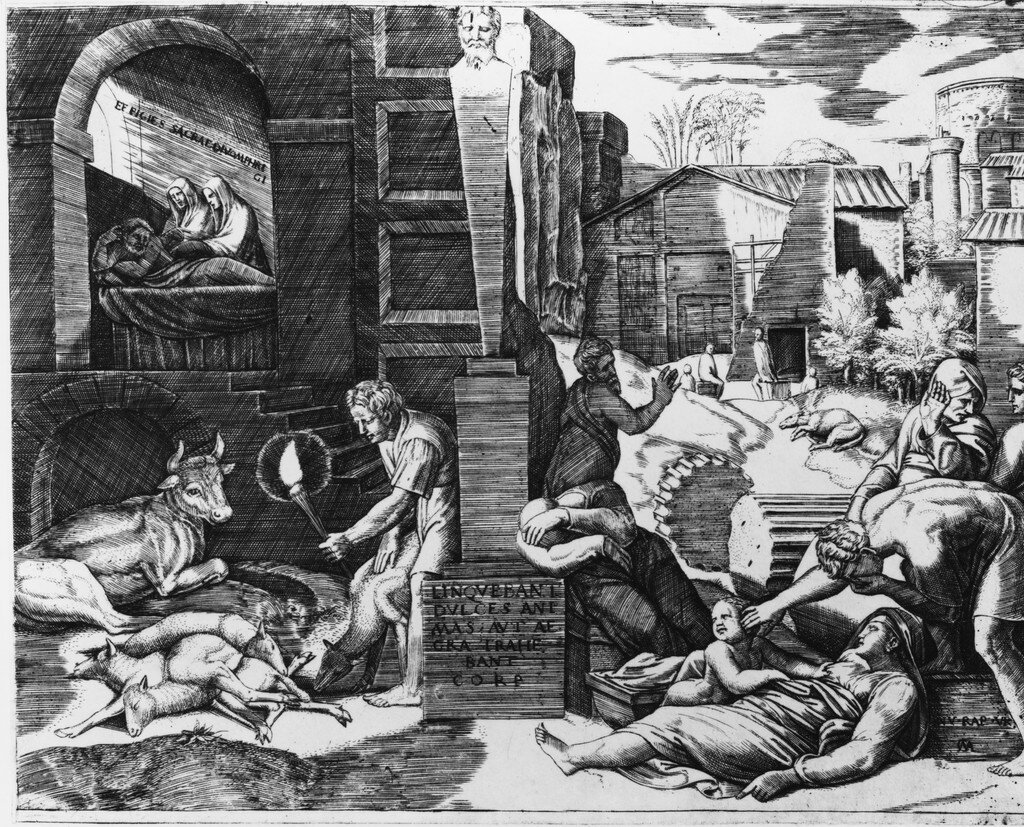
It so happened that in the month of October in the year of our Lord 1347, around the first of that month, twelve Genoese galleys, fleeing our Lord’s wrath which came down upon them for their misdeed, put in at the port in the city of Messina. They brought with them a plague that they carried down to the very marrow of their bones, so that if anyone so much as spoke to them, he was infected with a mortal sickness which brought on an immediate death that he could in no way avoid.
So begins one of the first historical accounts of the “Black Death” in late medieval Europe, written by the Sicilian chronicler Michele da Piazza. The plague was a truly terrifying pandemic. Modern estimates suggest that the disease may have killed as many as half those who contracted it, and when death came it was swift, agonizing, and utterly undignified. Consider this description, by another Italian eyewitness:
There are not words to describe how horrible these events have been and, in fact, whoever can say that they have not lived in utterly horrid conditions can truly consider themselves lucky. The infected die almost immediately. They swell beneath the armpits and in the groin, and fall over while talking. Fathers abandon their sons, wives their husbands, and one brother the other. In the end, everyone escapes and abandons anyone who might be infected. . . . And I, Agnolo di Tura, called the Fat, have buried five of my sons with my own hands.
Given the horror of these events, it’s not surprising that we find writers from this period wrestling with all sorts of difficult questions: how to avoid getting sick? How to avoid getting other people sick? How to continue maintain some semblance of normalcy when the world seems like’s been turned upside down? And above all: where is God amidst all this suffering and death?
These questions were even more pressing for those whose vocation called them to the front lines in the battle against the plague: physicians, who cared for the bodies of the sick; priests, who cared for their souls; friars, monks, and nuns, whose religious vows often required them to seek out the sick and care for their bodies and souls. And despite the grim observations of Agnolo the Fat, they didn’t all run away.
In the summer of 1527, the plague swept through Europe once again. But this time, it fell upon a society deeply divided—“polarized,” we would say—by the events of the Protestant Reformation. On top of all the old fears of death and social breakdown, perceptions of the disease were filtered through new layers of mistrust rooted in religious difference. Protestants regarded the plague as God’s judgment on Catholic decadence and idolatry; Catholics accused Protestants of weakening the unity of Christendom in a time of crisis. Both sides gleefully seized on examples of cowardice and other missteps to paint their enemies in the worst possible light.
By August of that year, the first victims of the plague were dying in the city of Wittenberg, where Martin Luther and his colleagues were laboring to reform the German churches. Just like many recent governments have done, the Elector John “the Steadfast” ordered a series of dramatic measures to combat the plague, including ordering the faculty of the University of Wittenberg—Luther included—to relocate to another city. Luther refused to leave. Together with his friend and colleague Johannes Bugenhagen, Luther stayed put in Wittenberg to care for the sick and the dying: preaching the Gospel, administering the sacraments, visiting the sick in their homes to provide pastoral and practical care, and eventually converting his own house (a former monastery) into a makeshift hospital.
By the time the plague died down in Wittenberg in the fall of that year, Luther was being criticized on both sides. Friends in the church and government believed he had been too reckless, ignoring the prince’s command to leave the city. But Catholic opponents, pointing to the aggressive measures the city had taken to isolate the sick from the healthy, accused the Lutherans of abandoning their flock in its time of greatest need.
Luther responded to these criticisms in an open letter titled, “Whether One May Flee from a Deadly Plague,” a masterpiece of pastoral guidance to a community in crisis. Luther’s main point may be summed up as follows: those in vocations with responsibilities to serve the common good—this would include city officials, doctors, and pastors, among others—are bound to remain in place. Christians are people who have been called by God, and the model for faithfully living out one’s calling is nothing other than Christ himself: “A good shepherd lays down his life for the sheep, but the hireling sees the wolf coming and flees” (John 10:11).
For those whose duties do not require it, however, Luther counsels balanced judgment and pragmatic common sense. On the one hand, Luther argues that fleeing from danger is not inherently wrong, and he multiplies examples from scripture to support this: Jacob fled from Esau, David fled from Saul, Paul fled from Damascus, etc., etc. On the other hand, Luther argues that the law of love compels us to help our neighbor in times of need, even when that help comes at risk to ourselves. “A man who will not help or support others,” Luther observes, “unless he can do so without affecting his safety or his property will never help his neighbor.” These are the ones to whom Christ will say, “I was sick and you did not visit me” (Matt 25:43).
Now, at this point one might object that times have changed since the sixteenth century. It’s not our job to care for the sick directly, especially not during a time of pandemic—that’s what the healthcare system is for. And Luther would actually agree. In point of fact, Luther’s Wittenberg was one of the first cities in Western Europe to appoint a full-time physician to care for the poor—at government expense! Luther saw this kind of arrangement as the ideal way of enacting the community’s obligation to care for needy, but he also recognized that in extreme circumstances, other measures may be necessary:
It would be well, where there is an efficient government in cities and states, to maintain municipal homes and hospitals staffed with people to take care of the sick so that patients from private homes can be sent there. . . . That would indeed be a fine, commendable, and Christian arrangement to which everyone should offer generous help and contributions, particularly the government. Where there are no such institutions—and they exist only in a few places—we must give hospital care and be nurses for one another in any extremity or risk the loss of salvation and the grace of God.
Strong words, these! But they are a strong reminder that whatever the early Protestant reformers like Martin Luther may have meant by teaching that salvation comes “through faith alone,” it certainly didn’t drive a wedge between our faith in God and the love and care we owe to our neighbors—far from it!
Most of Luther’s advice in this treatise is aimed at those fearful souls who were tempted to abandon their duties in a time of crisis. But he also acknowledges that there is another danger, what he calls “tempting God.” I will quote Luther at length here because it seems to me that his advice is particularly timely in our situation:
Others sin on the right hand. They are much too rash and reckless, tempting God and disregarding everything which might counteract death and the plague. They disdain the use of medicines; they do not avoid places and persons infected by the plague, but lightheartedly make sport of it and wish to prove how independent they are. They say that it is God’s punishment; if he wants to protect them he can do so without medicines or our carefulness. That is not trusting God but tempting him. . . .
No, my dear friends, that is no good. Use medicine; take potions which can help you; fumigate house, yard, and street; shun persons and places where your neighbor does not need your presence or has recovered, and act like a man who wants to help put out the burning city. What else is the epidemic but a fire which instead of consuming wood and straw devours life and body? You ought to think this way: “Very well, by God’s decree the enemy has sent us poison and deadly offal. Therefore I shall ask God mercifully to protect us. Then I shall fumigate, help purify the air, administer medicine, and take it. I shall avoid persons and places where my presence is not needed in order not to become contaminated and thus perchance infect and pollute others, and so cause their death as a result of my negligence. If God should wish to take me, he will surely find me, and I have done what he has expected of me and so I am not responsible for either my own death or the death of others. If my neighbor needs me, however, I shall not avoid place or person but will go freely, as stated above. See, this is such a God-fearing faith because it is neither brash nor foolhardy and does not tempt God.”
As our nation, our community, and our church continue to come to grips with the challenge of the COVID-19 pandemic, we hear a persistent drumbeat from all sides that we are in “uncharted waters.” In some ways, that may well be true. But Luther’s reflections on the plague are a good reminder that Christians have been dealing with deadly disease for centuries, and we have a body of accumulated wisdom to draw upon as we navigate these troubled waters. So let’s keep taking our potions (kale smoothies for me!), fumigating our houses (or at least using hand sanitizer), and shunning places where we’re not needed (social distancing) with a sense of urgency, like people who want to help put out a city on fire. This isn’t just good medical advice—it’s a spiritual necessity.
Fearfully and Wonderfully Made

I praise you because I am fearfully and wonderfully made. Psalm 114:19
Difficult seasons have a way of bringing to light just how uniquely God made each of us. We experience the losses differently, and we cope with them differently. All of us are probably grieving common losses of normalcy and predictability, but individual circumstances and responses can be so different. Are you extroverted, confined at home and grieving all the people you can’t see or hug? Or perhaps more introverted, grieving a loss of solitude while quarantined with your entire family 24/7? Losses are different, challenges are different, and the ways we cope are different as well.
There are parents trying to figure out how to work remotely from home for the first time, while homeschooling when they didn’t choose that, teenagers are missing their friends, college students are doing school online and perhaps feeling their wings have been clipped. Some of us live alone or fought loneliness even before this new and extreme isolation. All of us are trying to cope with our own challenges in our own ways.
Coping differences have the potential to drive us crazy, especially under the same roof! (“You ate the last bag of chips! Your jokes aren’t funny, how can you be so flippant about this? How can I get any work done with you playing your electric guitar? Why are you obsessing over your spread sheets? Why are you shopping online when our income is plummeting?”) As we are all trying to respond to each other with grace and compassion, it may help to think of these different approaches to coping as part of the unique and wonderful way God made our loved ones.
However, it may be the other side of that coin that is more challenging. We may view the ways other people are responding to this surreal season as more constructive or even more Christlike than the way we are. Maybe the helpers in the congregation are being creative about reaching out to assist others, extroverts are calling to check on everyone else, while the more introverted among use might be using the solitude for long times of prayer for individuals and the world. Some are catching up on household projects, some are cleaning diligently and spraying Lysol everywhere, or making new budgets to manage loss of income. Is anyone hearing or seeing what others are doing and judging yourself harshly for not doing it their way?
You also are fearfully and wonderfully made! Our God was intentional in creating you uniquely. He knows you better than anyone else - better than you know yourself - and He adores you - right here and now in the midst of the COVID crisis. Let’s intentionally invite the loving, compassionate and comforting presence of our Creator God, and seek His guidance for how we can best navigate these times in our own unique way.
The Lord your God is with you, the Mighty Warrior who saves.
He will take great delight in you,
In His love He will no longer rebuke you,
But will rejoice over you with singing.
Zephaniah 3:17
Despair and Praise

2 Chronicles starts out with some terrifying news, and the people were desperate. A multitude of the enemy army was coming against them! Through their leaders, they shared their desperation to God, with entire families there before the Lord. He told them through Jahaziel, a priest, not to fear; that the battle was the Lord’s. PRAISE was the catalyst God used to rout the enemy.
Jehoshaphat was King of Judah in this story. All of Judah was in desperation. He said to God, in the company of a great gathering of very desperate, terrified people, “We are powerless against this great horde that is coming against us. We do not know what to do, but our eyes are on you.”
Then “the Spirit of the Lord came on Jahaziel”, and he said, “Do not be afraid. You will not need to fight in this battle…. Stand firm, hold your position, and see the salvation of the Lord on our behalf.” (2 Chronicles 20:13-17)
We are not the first people who have lived in desperate times. We have great throngs of witnesses who have gone before us and now cheer us on. This story represents just one example. They are cheering us on to trust God. To rivet our eyes on Jesus, the author and finisher of our faith. To praise Him in all circumstances. Especially when we do not know what to do.
How can I praise God when I feel so desperate? Certainly I do not feel like praising; instead, I weep. I cry out to God in loud laments and protests: “Where are you? What are you doing? Are you doing ANYTHING? Because I don’t see it.”
And then.
I am still.
I listen.
I hear a song, sung over me. A song of deliverance. Of love. Of strength. And I remember.
I praise God for Who He is. For His character. He is always faithful, always merciful, always loving, always compassionate, and always with His children. I can praise Him for His absolute good rule and reign over everything. He overpowers evil with His goodness for our good and His glory. It is a promise! Sing praise to God! And sing loudly!

Real Conversations with God
Here is an audio blog on having real conversations with God. As the waves of news reports have rolled over me, I’ve been tempted to melt down or shut down. But my greatest help has been being able to bring every raw emotion to God.